

Why Choose FRP Over Metal Grating?
FRP (Fiberglass Reinforced Plastic) grating is increasingly replacing traditional metal grating in industries such as wastewater treatment, oil & gas, marine, and chemical plants. The main reasons include corrosion resistance, lightweight structure, safety performance, and long-term cost savings.
In short: FRP grating lasts longer, requires less maintenance, and performs better in harsh environments compared to steel or aluminum grating.
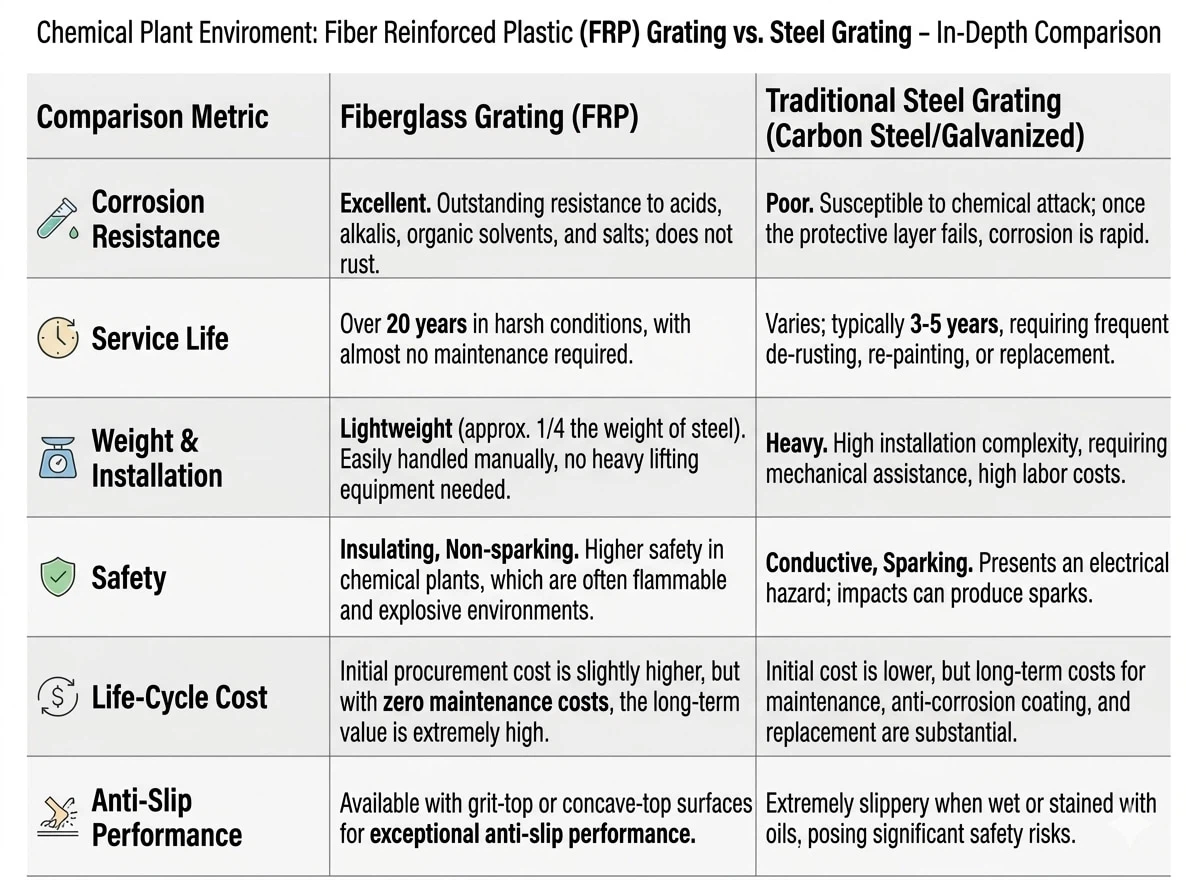
FRP vs Metal Grating: Key Differences
| Factor | FRP Grating | Metal Grating (Steel/Aluminum) |
|---|---|---|
| Corrosion Resistance | Excellent (non-rusting) | Poor (requires coating) |
| Weight | Lightweight (easy installation) | Heavy |
| Maintenance | Very low | High (painting, anti-rust) |
| Lifespan | 20–50 years | 5–15 years |
| Safety | Non-slip, non-conductive | Conductive, can be slippery |
| Initial Cost | Higher | Lower |
| Total Cost | Lower over time | Higher long-term |
1. Superior Corrosion Resistance
Unlike metal grating, FRP does not rust or corrode. It is highly resistant to chemicals, moisture, saltwater, and extreme environments. This makes it ideal for wastewater treatment plants, chemical processing facilities, and offshore platforms.
2. Lightweight but Strong
FRP grating is significantly lighter than steel, making it easier to transport and install. Despite its low weight, it offers excellent strength-to-weight ratio and can handle demanding load requirements.
This reduces installation time and labor costs, especially in large-scale industrial projects.
3. Low Maintenance & Long Lifespan
Metal grating requires regular maintenance such as painting, galvanizing, or rust treatment. In contrast, FRP grating requires minimal maintenance and can last over 20 years without significant degradation.
This results in lower lifecycle costs and fewer operational interruptions.
4. Enhanced Safety Performance
FRP grating offers multiple safety advantages:
- Non-slip surface (gritted or concave options)
- Non-conductive (ideal for electrical environments)
- Non-sparking (safe in explosive environments)
These features make FRP a safer choice for industrial walkways and platforms.
5. Better Long-Term Cost Efficiency
Although FRP grating may have a higher initial cost, it provides significant savings over time due to:
- No corrosion-related replacement
- Reduced maintenance costs
- Lower installation expenses
For most industrial applications, FRP becomes more cost-effective within just a few years.
Real Project Example
A wastewater treatment facility replaced steel grating with FRP grating across a 300 m² platform:
- Initial FRP cost: higher by 25%
- Maintenance savings over 5 years: 40%
- Total cost reduced by 30%
This demonstrates the long-term value of switching to FRP.
When Should You Choose Metal Instead?
Metal grating may still be suitable in some cases:
- Extremely high load structural applications
- Projects with very limited initial budgets
- Low-corrosion environments
However, in most industrial environments, FRP provides better overall performance.
Explore FRP Grating Solutions
If you are considering switching from metal to FRP, explore our full range of solutions here:
We provide customized solutions based on your project requirements, helping you achieve the best balance between performance and cost.
WhatsApp: +8613851475666
Email: info@preet.cn


