

Battery energy storage systems (BESS) are increasingly installed at utility sites, commercial facilities, renewable energy projects, and industrial plants. These installations contain battery enclosures, power conversion equipment, transformers, switchgear, cooling systems, and other components that require safe access for inspection and maintenance.
Access platforms and walkways are an important part of the overall site layout. Fiberglass reinforced plastic (FRP) grating may be considered for selected ancillary access structures where its relatively low weight and resistance to many corrosive environments are useful. However, BESS facilities have specific electrical, fire, ventilation, and emergency-response requirements. FRP grating must therefore be evaluated as one component of an engineered access system, not as a general-purpose safety solution.
This guide explains the main considerations for evaluating FRP grating around battery energy storage installations, including access planning, structural support, electrical working space, ventilation, fire protection, and maintenance.
1. Where FRP Grating May Be Considered in BESS Facilities
FRP grating may be evaluated for selected external access structures and ancillary maintenance areas, subject to the project's engineering and fire protection requirements. Potential locations include:
- External maintenance walkways: Access routes alongside equipment enclosures where the structural design permits an open-grid deck.
- Elevated service platforms: Platforms used to reach selected auxiliary equipment, cable routes, or mechanical systems.
- Utility access structures: Walkways and inspection areas associated with supporting infrastructure around the BESS installation.
- Drainage-related access areas: Selected access routes near site drainage infrastructure, provided that runoff and contamination risks are addressed.
FRP grating should not automatically be specified inside battery enclosures, above battery modules, or in areas exposed to potential thermal runaway, fire, or hazardous gas release. Whether a combustible composite material is acceptable in a particular location must be determined by the fire protection engineer and the authority having jurisdiction.
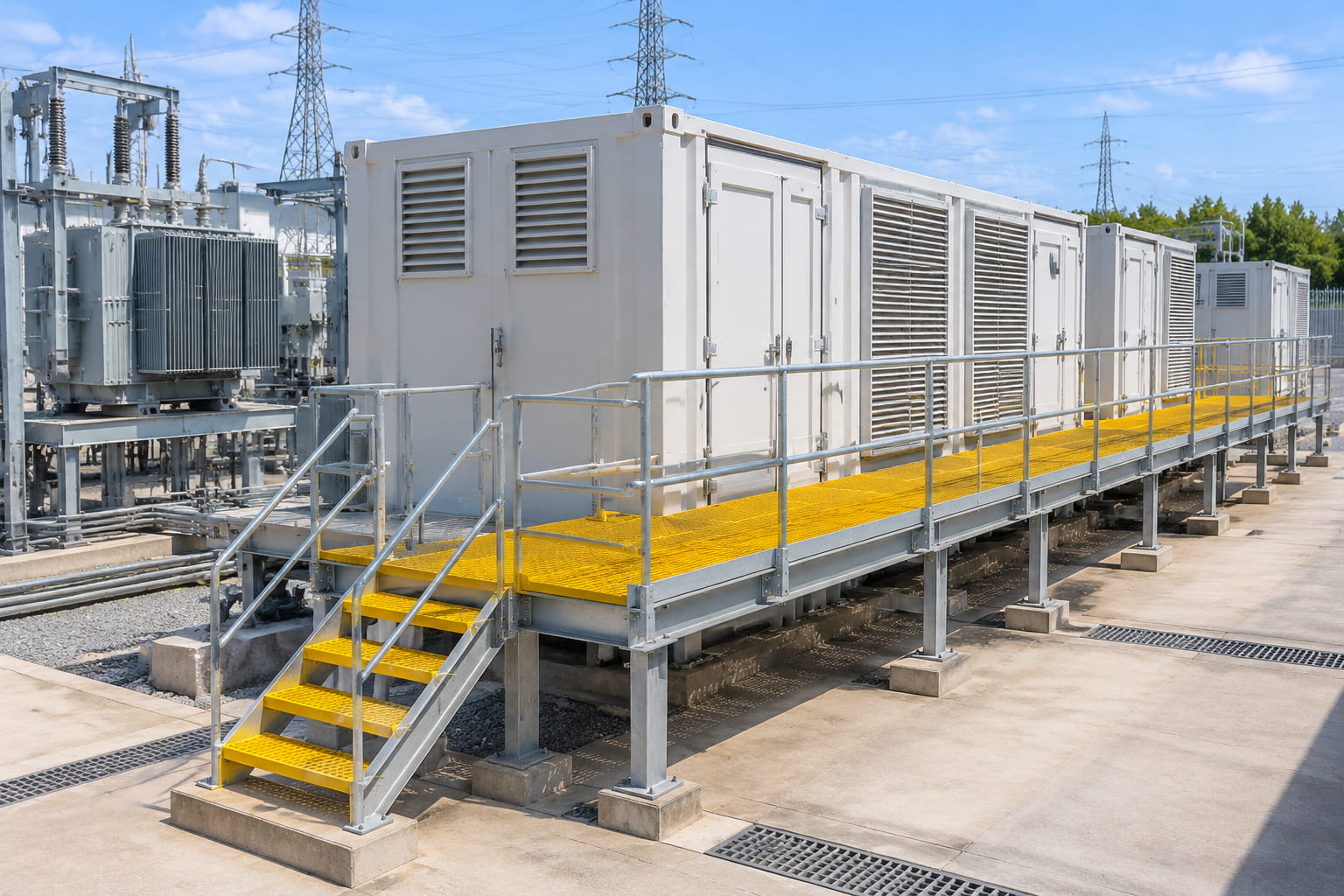
2. Understand the Different Access Requirements
A BESS facility contains equipment with different inspection and maintenance needs. A single walkway arrangement may not be suitable for every component.
Battery Enclosures
Battery enclosures require controlled access, manufacturer-defined service clearances, and emergency response provisions. Access routes should allow authorized personnel to reach designated doors and service points without obstructing ventilation outlets, emergency equipment, or escape routes.
Power Conversion Systems
Inverters and power conversion equipment may require regular inspection and maintenance. The access arrangement should provide sufficient space for equipment doors, removable components, lifting operations, and safe working positions.
Transformers and Switchgear
Electrical equipment may have specific access and working-space requirements. Platforms, guardrails, handrails, and adjacent structures must not reduce the clearances required by the applicable electrical codes or equipment manufacturers.
Cooling and Auxiliary Systems
Cooling equipment, pumps, fans, and auxiliary systems may require access at different elevations. The layout should consider maintenance removal paths, drainage, vibration, and the effect of nearby structures on airflow.
3. Selecting the Appropriate FRP Grating Type
If FRP grating is accepted for a specific access location, the selected panel should be matched to the structural design and exposure conditions.
Molded FRP Grating
Molded FRP grating has a grid structure formed by combining resin and reinforcing fibers in a mold. Its openings can allow water and air to pass through the panel. It may be considered for selected outdoor walkways where the panel's verified load-span characteristics meet the project requirements.
Pultruded FRP Grating
Pultruded FRP grating uses continuous longitudinal reinforcement in its load-bearing members. Its directional construction makes panel orientation especially important. The load-bearing direction must match the support arrangement and the manufacturer's technical documentation.
Resin and Surface Finish
Resin selection should account for the actual outdoor environment, including moisture, temperature, ultraviolet exposure, and any chemicals that may contact the walkway. A gritted or other suitable slip-resistant surface may be considered where wet conditions are expected.
Fire performance must be reviewed separately. Do not assume that a standard FRP grating panel is noncombustible, fireproof, or suitable for every BESS fire scenario. Obtain the exact product's available fire-test information and have its suitability assessed against the project requirements.
4. Structural Loads and Support Arrangement
FRP grating is a deck component supported by a structural frame. It does not replace the primary beams, columns, foundations, or equipment supports required by the BESS installation.
The design team should establish the following before selecting panel dimensions:
- Pedestrian loading: Determine the applicable live loads for maintenance personnel and the intended access category.
- Concentrated loads: Consider tools, replacement components, portable equipment, and maintenance activities.
- Support spacing: Confirm the clear span based on the selected panel's verified load-span data.
- Load direction: Align the panel's primary load-bearing direction with the approved support layout.
- Deflection and vibration: Check serviceability under expected static and dynamic conditions.
- Environmental loads: Account for applicable wind, snow, ice, temperature, and other site-specific actions on the complete access structure.
There is no universal support spacing suitable for every FRP panel. Capacity depends on the grating type, panel thickness, reinforcement, resin system, support conditions, loading, and allowable deflection. Use product-specific load-span tables and obtain engineering approval for the proposed arrangement.
5. Electrical Working Space and Equipment Clearances
Electrical access is a critical design issue at BESS sites. A walkway may be structurally adequate but still be unsuitable if it obstructs equipment doors, electrical working space, cable access, or emergency isolation points.
For example, OSHA 29 CFR 1910.303 specifies working-space and access provisions for covered electrical installations in the United States. The required dimensions depend on equipment characteristics, voltage, installation conditions, and the applicable provisions. Other jurisdictions may apply different electrical codes.
When planning an FRP access platform near electrical equipment, verify:
- Required clear working space in front of electrical equipment.
- Door swing and removable-panel clearance.
- Access to emergency disconnects and isolation devices.
- Clearance from energized components and exposed conductors.
- Safe access for qualified maintenance personnel.
- Whether platform framing, fasteners, handrails, or other components create additional electrical hazards.
Important: Standard FRP grating must not be treated as certified electrical insulation or as a substitute for electrical approach distances, barriers, grounding, lockout procedures, or other required protective measures. Any electrical properties relied upon in a design must be supported by specific product testing and approval.
6. Ventilation and Airflow Considerations
Battery energy storage installations may use dedicated ventilation and thermal management systems. Equipment manufacturers define airflow paths, intake locations, exhaust locations, and required clearances for their products.
Open-grid FRP grating allows air to pass through the deck, but this does not automatically make it suitable for every ventilation arrangement. A platform, support beam, handrail, or adjacent enclosure can still obstruct an intake or exhaust path.
Before installation, coordinate the access structure with the mechanical and electrical layouts. Check:
- Air intake and exhaust locations on battery and power conversion enclosures.
- Required clearance around fans, cooling units, and ventilation outlets.
- Potential recirculation of hot exhaust air.
- Access needed for filter replacement and cooling-system maintenance.
- Whether the platform could affect gas dispersion or emergency ventilation assumptions.
Ventilation and gas dispersion should be evaluated by the responsible engineering team. An open-grid floor is not a substitute for the ventilation and gas detection systems required by the BESS design.
7. Fire Protection and Emergency Access
Battery energy storage systems have fire and emergency-response considerations that differ from ordinary industrial platforms. Battery chemistry, system capacity, enclosure design, installation location, separation distances, detection, suppression, and emergency procedures all affect the facility's safety strategy.
NFPA 855, Standard for the Installation of Stationary Energy Storage Systems, addresses hazards associated with stationary energy storage installations. Its scope includes fire protection, detection, suppression, explosion control, exhaust ventilation, gas detection, and thermal runaway considerations.
For an FRP access structure, the design team should review:
- Material fire performance: Confirm whether the proposed FRP product meets the project's specified fire performance criteria.
- Location relative to battery units: Determine whether the material is acceptable in the intended fire exposure zone.
- Emergency routes: Ensure walkways, stairs, and platforms do not obstruct emergency access or evacuation.
- Firefighting access: Coordinate platform placement with the approved emergency response plan.
- Drainage and runoff: Evaluate where water or other liquids may flow during testing, firefighting, or emergency operations.
- Post-incident inspection: Establish how access structures and materials will be assessed after exposure to abnormal heat or fire.
FRP grating should not be selected solely because it is corrosion resistant or lightweight. If a project requires noncombustible materials or has strict fire exposure limitations, another flooring material may be more appropriate.
8. Drainage and Outdoor Weather Exposure
Many BESS installations are located outdoors and exposed to rain, snow, temperature changes, and seasonal maintenance conditions. An open-grid deck may allow water to drain through the walking surface, but the complete drainage arrangement still needs to be checked.
Consider the following:
- Where water passing through the grating will discharge.
- Whether runoff could reach electrical enclosures, cable entries, or sensitive equipment.
- Whether ice or snow may accumulate on the walking surface or supporting structure.
- Whether the selected surface finish provides suitable traction for expected conditions.
- Whether cleaning chemicals, de-icing products, or site contaminants are compatible with the resin system and fasteners.
- Whether drainage paths can be inspected and maintained without disturbing electrical equipment.
In cold climates, open-grid construction does not eliminate ice hazards. The facility operator should establish appropriate snow and ice inspection and maintenance procedures.
9. Installation and Inspection of FRP Access Platforms
Installation should follow approved drawings and the manufacturer's instructions. Before work begins, confirm the supporting structure, panel identification, connection details, and site access restrictions.
- Review approved drawings: Confirm walkway location, equipment clearances, panel layout, and access routes.
- Inspect the support frame: Check beam alignment, bearing surfaces, fixing locations, and structural completion.
- Confirm panel orientation: Install molded or pultruded panels according to the approved load-bearing direction.
- Use specified fasteners: Install compatible clips and bolts according to the approved connection details.
- Inspect cut edges and joints: Check field modifications, panel gaps, perimeter support, and access openings.
- Verify equipment access: Confirm that the completed platform does not obstruct doors, ventilation, emergency devices, or electrical working space.
Routine inspection should include panel damage, loose fasteners, support corrosion, surface wear, guardrail condition, and drainage. Any damage potentially related to heat exposure or a battery incident should be assessed before the platform is returned to service.
10. Information to Provide When Specifying FRP Grating for BESS Projects
To evaluate whether FRP grating is suitable for a particular BESS access application, provide the manufacturer and engineering team with the following information:
- Project location and applicable building, electrical, and fire codes.
- BESS layout and equipment manufacturer information.
- Exact location and purpose of the proposed access platform.
- Whether the platform is inside or outside the battery enclosure area.
- Required pedestrian and maintenance loads.
- Support beam arrangement and proposed panel spans.
- Environmental exposure, including temperature, UV, moisture, and chemicals.
- Required fire performance and material restrictions.
- Electrical working-space and equipment access requirements.
- Ventilation, drainage, emergency access, and maintenance requirements.
- Required product test reports, load-span data, and technical documentation.
The project engineer and relevant fire protection and electrical specialists should determine whether FRP grating is acceptable at the proposed location. If the project's fire strategy or material restrictions do not permit FRP, a different flooring system should be selected.
Conclusion
FRP grating may be considered for selected external maintenance walkways and ancillary access platforms at battery energy storage facilities. Its relatively low weight and resistance to many corrosive environments can be useful, but these properties alone do not establish suitability for a BESS installation.
Structural loading, electrical working space, ventilation, fire performance, emergency access, and outdoor weather exposure must all be evaluated before material selection. In particular, standard FRP grating should never be assumed to provide electrical insulation or to satisfy fire protection requirements without product-specific evidence and project approval.
A coordinated design involving the structural, electrical, mechanical, and fire protection teams is the best way to determine whether FRP grating is appropriate for a particular BESS access application.
Contact PREET for FRP Grating Solutions
PREET supplies FRP molded grating and related fiberglass products for industrial access and platform applications. Contact our team to discuss your project environment, panel requirements, and available technical documentation.
- WhatsApp: +86 138 5147 5666
- Email: info@preet.cn
- Website: https://www.preetgrating.com/
- Molded FRP Grating: View Product Details


