

FRP Grating for Battery Manufacturing Plants: Corrosion Exposure, Electrical Safety and Maintenance Access
Battery manufacturing facilities contain a variety of production equipment, utility systems, chemical handling areas and inspection stations. These environments require carefully designed access routes so that maintenance personnel can reach equipment safely and efficiently.
Flooring and platform materials are an important part of this planning. Fiberglass reinforced plastic (FRP) grating is one option worth evaluating for selected maintenance walkways, equipment platforms and service areas. Its relatively low weight, corrosion resistance and electrical insulating characteristics can offer advantages over conventional metallic grating in suitable applications.
However, battery production involves different technologies and chemical processes. The material selection process must consider the actual chemicals, operating conditions, structural loads and facility safety requirements rather than assuming that one FRP product is suitable for every production area.
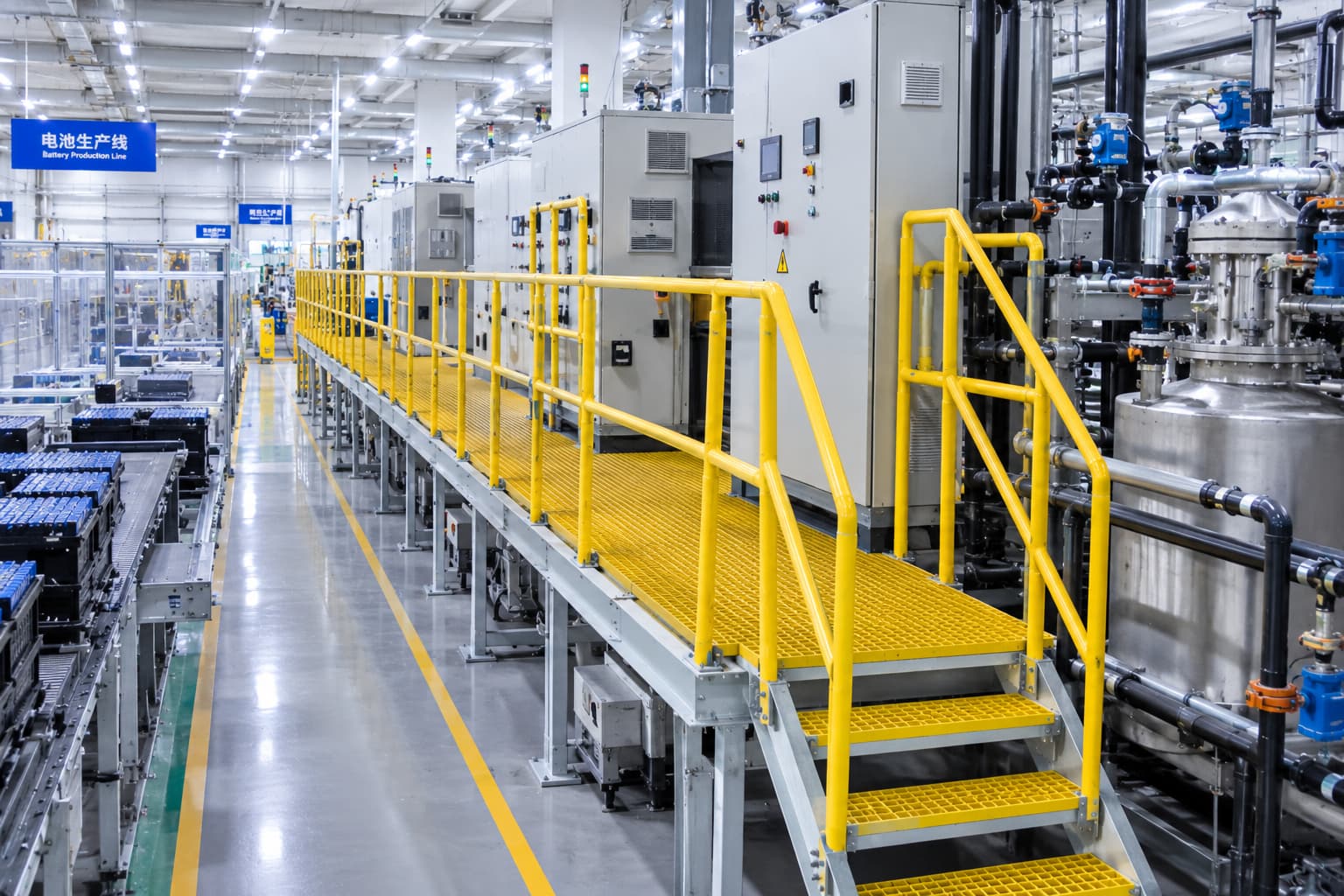
1. Where Can FRP Grating Be Considered in Battery Manufacturing Plants?
FRP grating may be evaluated for selected non-process access areas where maintenance access, corrosion exposure or electrical considerations influence the flooring specification.
Equipment Maintenance Walkways
Production lines include pumps, motors, utility connections, ventilation equipment and other components that require periodic inspection. Elevated or ground-level FRP walkways can provide defined access routes around suitable equipment, subject to the plant's structural and safety design.
Utility and Service Platforms
Some facilities have service platforms near piping, cable routes, ventilation systems and auxiliary equipment. FRP grating can be considered where a lightweight, corrosion-resistant open-grid walking surface is appropriate.
Drainage and Washdown Areas
Where the process design permits wet cleaning or washdown, open-grid grating may allow liquids to pass through instead of collecting on a solid walking surface. The drainage arrangement must be coordinated with the plant's chemical containment, wastewater treatment and housekeeping systems.
Inspection and Access Areas
Platforms around selected instruments, valves and utility equipment can be designed to improve maintenance access. The layout should provide sufficient working space and must not obstruct emergency routes, equipment removal or required process clearances.
2. Corrosion Resistance and Chemical Compatibility
One of the main reasons engineers consider FRP grating is its resistance to corrosion. Unlike ordinary carbon steel, FRP does not rust in the conventional way when exposed to moisture and many corrosive environments.
Nevertheless, chemical resistance depends on the resin system, chemical concentration, temperature, exposure duration and other operating conditions. Battery manufacturing processes may involve different materials depending on the battery chemistry and production stage.
Identify the Actual Chemical Exposure
Before specifying FRP grating, the project team should identify chemicals that may contact the platform through normal operation, cleaning, leakage or accidental spills. Relevant information should be taken from process documentation and current Safety Data Sheets (SDS).
- Identify the chemicals and their concentrations.
- Confirm normal and maximum operating temperatures.
- Review possible splash, spill and continuous-contact conditions.
- Evaluate cleaning agents and maintenance chemicals.
- Confirm resin compatibility with the expected exposure conditions.
Do not assume that a general corrosion-resistance description guarantees compatibility with every electrolyte, solvent or cleaning chemical. The selected resin and grating construction should be reviewed against the actual chemical exposure.
3. Electrical Insulation: A Useful Property with Important Limits
FRP materials are generally electrically non-conductive compared with conventional metallic grating. This characteristic may be useful when evaluating access platforms near electrical equipment or cable installations.
However, FRP grating must not be treated as a substitute for electrical protection measures. It does not eliminate electric shock risks, guarantee a safe working environment or replace grounding, bonding, isolation, guarding and electrical work procedures.
Consider the Complete Electrical Installation
Engineers should assess the complete platform system, including supporting steelwork, fasteners, nearby equipment, cable routing and any conductive contamination. Metallic support structures and connected components may still create electrical paths.
Where electrical insulation is a project requirement, the specific FRP product and complete installation should be evaluated against the applicable electrical design and safety requirements.
4. Slip Resistance and Open-Grid Drainage
Production and utility areas may experience dust, moisture or occasional liquid contamination. The walking surface should therefore be selected according to the expected operating conditions.
FRP grating is available with different surface configurations. Depending on the product, options may include molded concave surfaces or grit-coated anti-slip surfaces.
- Concave surface: A molded surface profile that can provide additional traction in suitable applications.
- Gritted surface: An abrasive surface option that can be considered where greater slip resistance is required.
- Open-grid structure: Allows suitable liquids and debris to pass through, reducing the accumulation of standing liquid on the walking surface.
The surface should be selected based on the actual contaminants, footwear, cleaning methods and maintenance procedures. Open-grid flooring also requires an appropriate drainage and containment arrangement beneath the platform.
5. Load Capacity and Structural Support Requirements
Battery manufacturing platforms may carry maintenance personnel, tools, movable equipment and occasionally materials. The grating panel must be designed for the loads expected in its specific location.
Important design considerations include:
- Uniformly distributed loads from personnel and equipment.
- Concentrated loads from equipment feet or temporary maintenance tools.
- Panel span and support spacing.
- Deflection limits and acceptable walking comfort.
- Support frame strength and connection details.
- Openings, cutouts and access points around equipment.
Engineers should use the manufacturer's load tables and project-specific calculations to determine the appropriate panel thickness, span and support arrangement. Do not select grating based only on appearance or panel dimensions.
6. Fire and Process Safety Must Be Evaluated Separately
Battery manufacturing facilities require careful management of chemical, electrical and fire hazards. For lithium-ion battery production in particular, OSHA identifies hazards associated with flammable electrolytes, electrical energy and thermal runaway.
FRP grating selection must therefore be coordinated with the facility's fire protection strategy and process hazard assessment. A resin's stated flame-retardant characteristic does not mean that the grating is fireproof or suitable for every fire exposure.
FRP grating is not an explosion-proof product, a fire barrier or a substitute for ventilation, gas detection, fire protection systems, emergency planning or hazardous-area electrical design. The project engineer and facility safety team should determine whether FRP is permitted in each proposed location.
7. FRP Grating vs. Steel Grating for Selected Plant Access Areas
| Consideration | FRP Grating | Steel Grating |
|---|---|---|
| Corrosion behavior | Does not rust like carbon steel; chemical compatibility must be verified. | May require protective coatings or corrosion-resistant grades. |
| Electrical characteristics | Generally non-conductive material. | Conductive. |
| Weight | Generally lighter than comparable steel systems. | Generally heavier. |
| Maintenance | May reduce corrosion-related maintenance in suitable environments. | Coatings and corrosion condition may require periodic attention. |
| Fire performance | Depends on the specific resin and tested product properties. | Steel is non-combustible, but its structural performance changes at elevated temperatures. |
| Structural design | Requires FRP-specific load tables, support design and connection details. | Requires steel structural calculations and suitable corrosion protection. |
The best choice depends on the application. FRP may be advantageous in selected corrosive or electrically sensitive areas, while steel may be more appropriate where project-specific fire, temperature, impact or structural requirements govern.
8. Installation and Maintenance Considerations
Correct installation is essential for the long-term performance of FRP grating platforms. Panels should be supported and secured according to the manufacturer's installation guidance and the approved engineering drawings.
Installation Checklist
- Verify the support spacing and structural frame before panel installation.
- Check panel orientation, dimensions and cutout locations.
- Use compatible clips or approved fastening systems.
- Protect cut edges where required by the product manufacturer's instructions.
- Confirm that panels are securely fixed and cannot move during normal use.
- Maintain safe clearances around pipes, cable routes and equipment.
Routine Inspection
Maintenance personnel should periodically inspect grating panels, connections and supporting structures. Look for cracks, impact damage, loose clips, excessive deflection, surface wear and signs of chemical deterioration.
Any damaged panel or connection should be assessed and repaired or replaced according to the manufacturer's recommendations and the facility's maintenance procedures.
9. How to Select FRP Grating for a Battery Manufacturing Project
Before requesting a quotation, prepare the following project information:
- Application location and intended use.
- Battery production process and chemical exposure information.
- Required resin system and chemical compatibility criteria.
- Panel dimensions, thickness and mesh size.
- Required surface type and slip-resistance considerations.
- Design loads, support spacing and deflection requirements.
- Fire performance and applicable project standards.
- Installation environment and fastening requirements.
Providing these details helps the supplier evaluate whether a particular FRP grating product is suitable for the proposed application. Final selection should be confirmed by the project's qualified engineering and safety teams.
Conclusion
FRP grating can be considered for selected maintenance walkways, service platforms and equipment access areas in battery manufacturing plants. Its lightweight construction, corrosion resistance and generally non-conductive material characteristics may offer practical benefits when the product is correctly specified.
Successful application depends on more than choosing a grating panel. Chemical compatibility, structural loading, slip resistance, electrical design and fire protection requirements must all be evaluated for the actual production environment.
PREET provides FRP grating solutions for industrial applications. Contact our team to discuss your project requirements and identify a suitable product configuration.
Contact PREET
WhatsApp: +86 138 5147 5666
Email: info@preet.cn
Product: Molded FRP Grating


