

What Is an FRP Kick Plate?
An FRP kick plate is a fiberglass-reinforced plastic component used along the lower edges of platforms, walkways, and access structures. In suitable installations, it can help reduce the risk of tools or other objects sliding off an exposed platform edge. It may also form part of an industrial platform's edge-protection arrangement.
FRP kick plates are relevant to projects where corrosion resistance, low maintenance, and electrical insulation are important material considerations. However, a kick plate is not a substitute for a guardrail or other required fall-protection system. Its dimensions and installation must match the project's safety requirements.
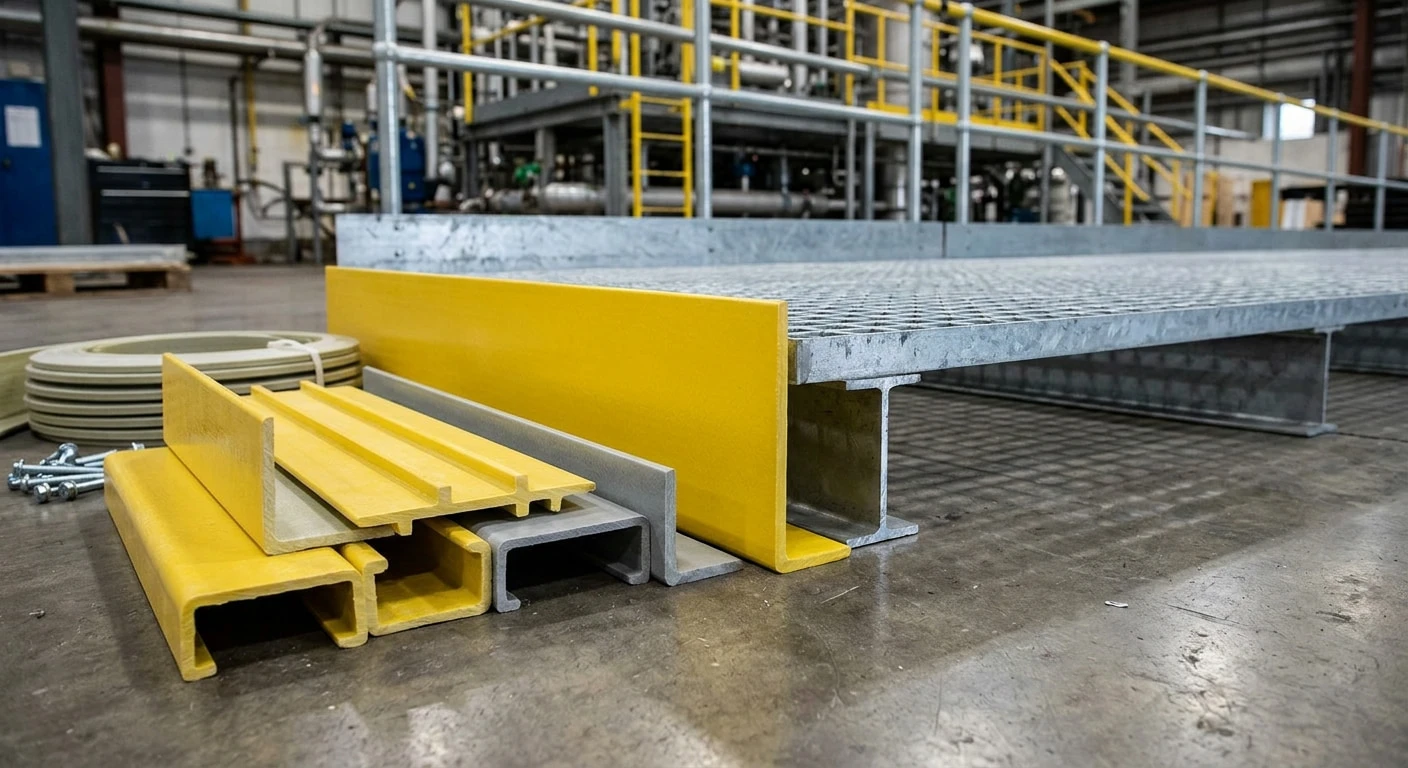
FRP kick plate profiles can be incorporated into industrial walkway and platform edge-protection systems when appropriately specified.
FRP Kick Plate Sizes and Weight
PREET's product catalog lists three kick plate height options. The table below reproduces the available catalog data. Width, thickness, and sectional area are not fully specified for these kick plate entries, so they should be confirmed with the manufacturer before ordering.
| Catalog Product | Height (mm) | Catalog Weight (kg/m) | Width / Thickness |
|---|---|---|---|
| FRP Kick Plate | 100 | 0.712 | Confirm with manufacturer |
| FRP Kick Plate | 150 | 1.073 | Confirm with manufacturer |
| FRP Kick Plate | 200 | 1.420 | Confirm with manufacturer |
Specification note: The values above are catalog-listed product data, not a complete engineering specification. Confirm the required cross-section, material details, length, connection method, and current availability with PREET before finalizing the purchase.
How to Choose an FRP Kick Plate Height
The appropriate kick plate height depends on the platform design, the risk of objects falling from the edge, the applicable project requirements, and how the plate connects to the surrounding structure. The catalog's 100 mm, 150 mm, and 200 mm options are available starting points for a supplier discussion-not universal recommendations for every installation.
1. Review the platform layout
Identify exposed edges, access points, corners, changes in level, and areas where small objects could slide or roll off the platform. Check whether the kick plate needs to run continuously along an edge or fit around equipment and access openings.
2. Confirm the applicable safety requirements
Check the project specification and relevant local requirements for toe boards, edge protection, and fall prevention. Do not assume that selecting a particular FRP kick plate height automatically satisfies the requirements for a complete platform protection system.
3. Check compatibility with the supporting structure
Confirm the mounting surface, attachment arrangement, connection spacing, and available clearance. The kick plate should be compatible with the platform frame and adjacent components. Connection details should be reviewed for the actual installation rather than selected from height alone.
4. Consider the operating environment
For industrial facilities, review exposure to water, chemicals, sunlight, temperature changes, and cleaning agents. The suitability of an FRP component depends on its material formulation and service conditions. Ask the supplier to confirm relevant product information where chemical resistance, fire performance, or other specific properties are required.
Where Are FRP Kick Plates Used?
- Industrial walkways: Along suitable exposed platform edges to help prevent small objects from slipping off.
- Maintenance platforms: Around work areas where tools and components may be present near an edge.
- Corrosion-prone facilities: In applications where an appropriately specified FRP component may offer advantages over materials susceptible to corrosion.
- Equipment access structures: As part of a properly designed platform edge assembly.
- FRP platform systems: Integrated with compatible frames, grating, and connection hardware where the system design allows.
These are potential application categories. The selected kick plate and its fastening arrangement must be suitable for the specific project and must not obstruct access, drainage, or required safety equipment.
FRP Kick Plates and Other FRP Profiles
Kick plates serve a different purpose from the primary structural members in a platform. When specifying a complete FRP structure, distinguish the edge-protection component from the beams, channels, tubes, and grating that support people or equipment.
| Component | Main Function | Key Checks |
|---|---|---|
| FRP kick plate | Platform edge and object-retention detail | Height, cross-section, attachment, project safety requirements |
| FRP grating | Walking or working surface | Load, span, panel dimensions, surface type |
| FRP C channel | Structural support or frame member | Section geometry, loads, span, connections |
| FRP angle profile | Corner connections and support details | Leg dimensions, thickness, fastening method |
Explore related products: FRP Pultrusion Profiles, FRP Grating, and FRP Walkway Grating.
What Information Should You Provide When Requesting a Quote?
To help the supplier identify the appropriate kick plate configuration, include the following information in your inquiry:
- Required kick plate height and total length.
- Project drawings and platform edge details.
- Required cross-section, width, and thickness, if already specified.
- Mounting arrangement and connection requirements.
- Operating environment and any required material or performance documentation.
- Quantity, requested color, and delivery destination.
If the required width, thickness, or connection details are not yet known, provide the project drawing and ask the supplier to confirm the available configuration. Do not assume that the catalog height alone defines the full product.
Conclusion
FRP kick plates can be a useful component in industrial walkway and platform edge assemblies when the product and installation are properly specified. PREET's catalog lists 100 mm, 150 mm, and 200 mm height options with corresponding weights of 0.712 kg/m, 1.073 kg/m, and 1.420 kg/m. Other dimensions should be confirmed with the manufacturer before ordering.
For product information or a quotation, contact PREET:


