

What Is an FRP Angle Profile?
An FRP angle profile, also called a fiberglass angle or FRP L-profile, is a pultruded structural component with an L-shaped cross-section. It is used to connect, reinforce, or support components in industrial structures where corrosion resistance, electrical insulation, and reduced maintenance are important considerations.
Unlike a flat strip, an angle profile has two legs that meet at a corner. This geometry can help connect perpendicular surfaces and form structural frames, brackets, equipment supports, and edge reinforcements. The suitability of a particular profile depends on its dimensions, material properties, connection details, and the loads acting on the assembly.
PREET's product catalog lists six FRP angle sizes, from 25 × 25 mm to 125 × 125 mm. The following table reproduces the catalog's listed dimensions, sectional areas, and weights.
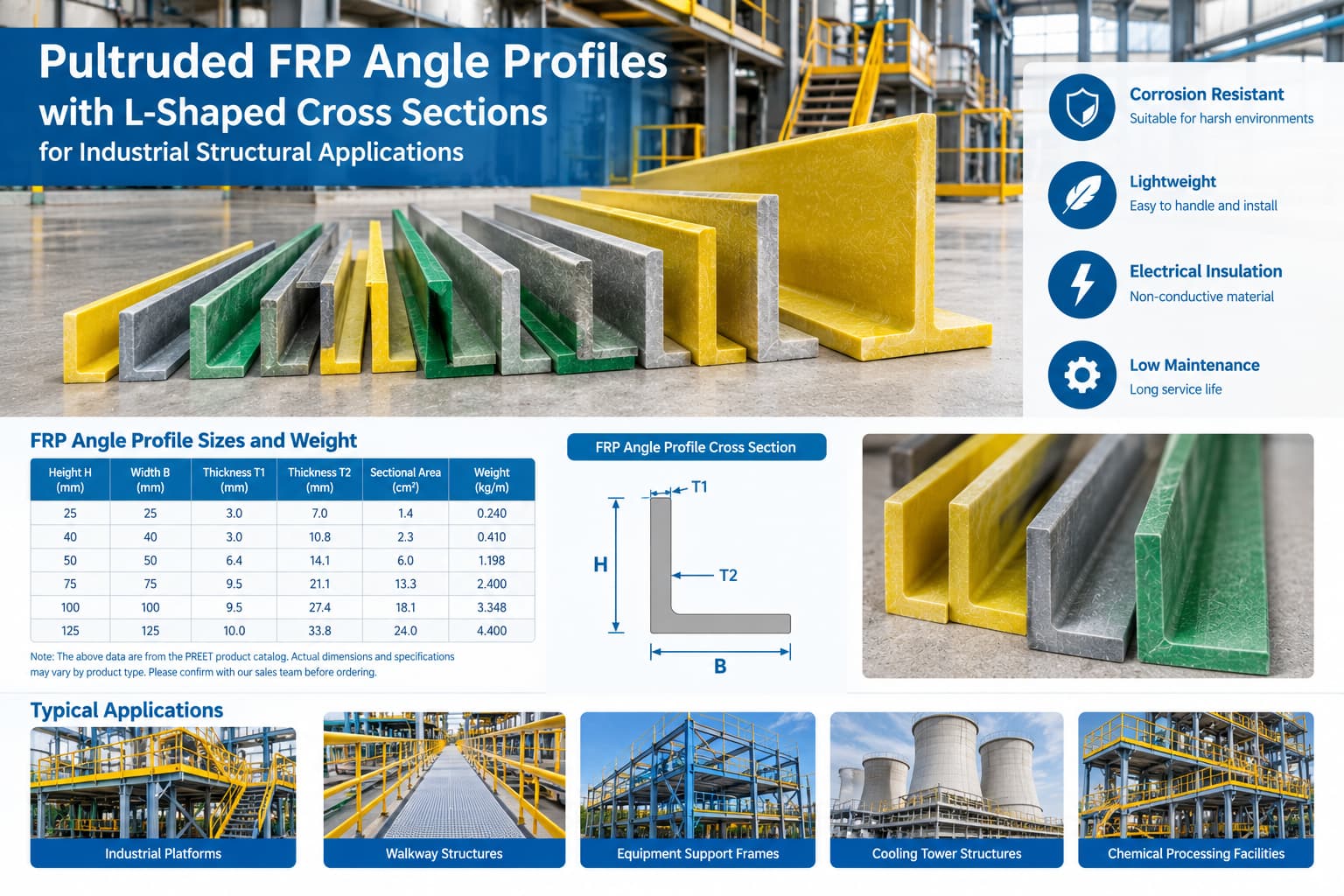
Pultruded fiberglass angle profiles for industrial framing, supports, and structural connections.
FRP Angle Profile Sizes and Weight Chart
The table below uses the dimensions and values published in the PREET product catalog. T1 and T2 are retained as the catalog's thickness labels; they should not be assumed to represent identical leg thicknesses.
| Height H (mm) | Width B (mm) | Thickness T1 (mm) | Thickness T2 (mm) | Sectional Area (cm²) | Weight (kg/m) |
|---|---|---|---|---|---|
| 25 | 25 | 3.0 | 7.0 | 1.4 | 0.240 |
| 40 | 40 | 3.0 | 10.8 | 2.3 | 0.410 |
| 50 | 50 | 6.4 | 14.1 | 6.0 | 1.198 |
| 75 | 75 | 9.5 | 21.1 | 13.3 | 2.400 |
| 100 | 100 | 9.5 | 27.4 | 18.1 | 3.348 |
| 125 | 125 | 10.0 | 33.8 | 24.0 | 4.400 |
Important: These are catalog-listed specifications, not a structural design approval. Confirm the exact profile drawing, dimensions, tolerances, and applicable product configuration with the supplier before ordering or using the profile in a load-bearing assembly.
How to Read FRP Angle Dimensions
1. Height and width
Height H and width B describe the two main legs of the angle profile. Equal values, such as 50 × 50 mm, indicate a nominal equal-leg configuration in the catalog. The required leg dimensions depend on the connection geometry, available installation space, and how the profile will be supported.
2. Thickness T1 and T2
The catalog identifies two thickness values, T1 and T2. Because the listed values are not always the same, do not simplify the specification to a single thickness without checking the relevant cross-sectional drawing. When requesting a quotation, provide the catalog size and ask the supplier to confirm the exact section geometry.
3. Sectional area
Sectional area is the cross-sectional area of the profile, expressed in square centimeters in the catalog. It is one of the parameters engineers use when evaluating a structural section, but it does not independently establish bending strength, load capacity, or allowable span.
4. Weight per meter
Weight in kg/m helps estimate the material quantity and handling weight for a project. To estimate the total profile weight, multiply the catalog weight per meter by the total purchased length, then account separately for connectors, fasteners, and other components.
How to Choose the Right FRP Angle Profile
Step 1: Define the structural function
Determine whether the angle will serve as a bracket, frame connection, edge support, equipment support, or reinforcement. A profile used mainly to connect components may have different design requirements from one carrying sustained loads.
Step 2: Identify the loads and support conditions
Document the expected loads, load direction, support spacing, connection locations, and any vibration or impact conditions. The catalog weight and sectional area alone are not sufficient to establish a safe load rating. Structural calculations should use verified material properties and the actual installation configuration.
Step 3: Check the connection design
Confirm how the angle will be fastened to adjacent profiles, panels, or equipment. Hole locations, edge distances, fastener type, local bearing, and installation tolerances can affect connection performance. Avoid selecting a profile solely because its nominal dimensions fit the space.
Step 4: Consider the operating environment
FRP pultruded profiles are used in industrial environments where corrosion resistance and electrical insulation can be beneficial. However, chemical exposure, temperature, ultraviolet exposure, and fire-performance requirements should be reviewed for the actual project. Confirm the resin system and relevant performance documentation rather than assuming every FRP profile has identical resistance.
Step 5: Confirm the specification before ordering
Share the required size, length, quantity, connection drawing, environmental conditions, and intended use with the supplier. If the application is load-bearing, request the relevant technical data and engineering review before finalizing the profile.
Typical Applications of Fiberglass Angle Profiles
- Industrial frames and brackets: Connections and support components in equipment and process areas.
- Corrosion-resistant platforms: Supporting or connecting components in suitable FRP platform assemblies.
- Walkway and fence systems: Framing and connection details, subject to project design.
- Electrical installations: Structural supports where the electrical-insulation properties of FRP are relevant.
- Cooling tower and equipment supports: Components selected according to the actual loading and environmental requirements.
These are potential application categories, not confirmation that every angle size is suitable for every use. The selected section and connections must be verified for the intended service conditions.
FRP Angle vs. Other Pultruded FRP Profiles
| Profile type | Typical design role | What to verify |
|---|---|---|
| FRP angle | Brackets, corner connections, edge supports | Leg dimensions, thickness, fastening details |
| FRP C channel | Channel-shaped supports and framing | Section geometry, orientation, span, loading |
| FRP I beam | Beam-type structural members | Beam dimensions, bending, deflection, connections |
| FRP square or rectangular tube | Enclosed-section frames and supports | Outer dimensions, wall thickness, load direction |
Explore related products: FRP Pultrusion Profiles, FRP C Channel, FRP Square Tube, and Fiberglass Rectangular Tube.
What to Include in an FRP Angle Profile Inquiry
To help the supplier confirm the correct profile, prepare the following information:
- Required H × B dimensions and the catalog thickness designation.
- Required lengths, quantities, and any cutting requirements.
- Application drawings and connection details.
- Expected loads, support conditions, and installation orientation.
- Environmental exposure and any required resin or performance documentation.
- Requested color and any project-specific requirements.
Conclusion
Choosing an FRP angle profile requires more than matching an L-shaped section to a nominal size. Compare the catalog dimensions, thickness values, sectional area, and weight, then confirm the connection design, operating environment, and structural requirements. Using verified product data and project-specific engineering checks helps reduce specification errors and supports a more reliable installation.
For product information or a quotation, contact PREET:


