

Why Are FRP Grating Cutouts Important?
FRP grating is often installed around pipes, drains, columns, tanks, valves, equipment bases and other obstacles in industrial facilities. Because these obstacles rarely align perfectly with standard grating panel dimensions, cutouts are commonly required during design and installation.
A properly designed opening should provide enough clearance for the object while maintaining adequate support around the remaining grating panel. An oversized or poorly positioned cutout can reduce the effective bearing area, weaken the panel edge and create installation or safety problems.
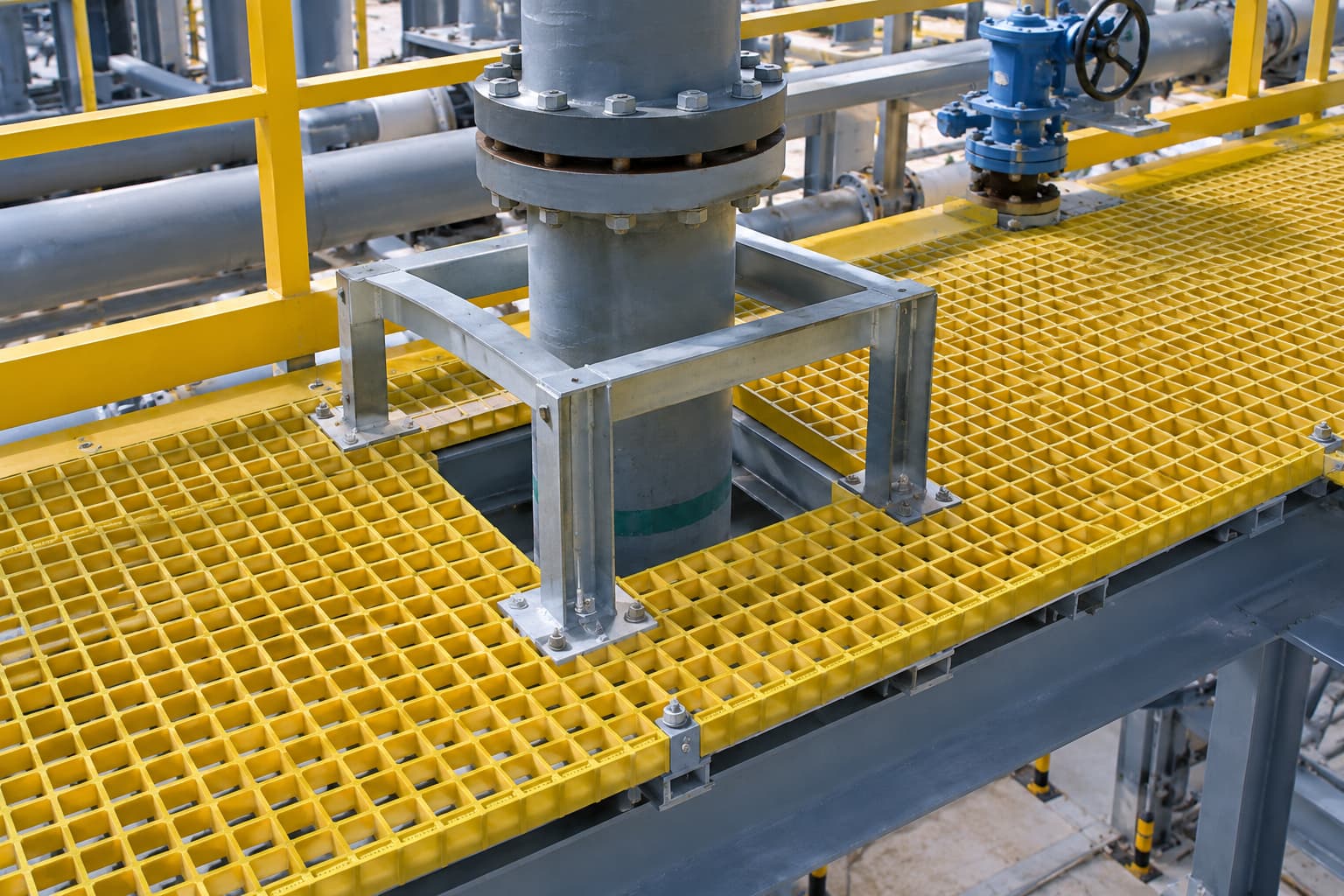
FRP grating cutouts should be coordinated with surrounding pipes, equipment and structural supports before fabrication.
Where Are FRP Grating Cutouts Commonly Required?
Industrial platforms and walkways often contain multiple penetrations and obstructions. Typical FRP grating openings include:
- Process and utility pipes
- Drainage pipes and floor drains
- Valves and pipe fittings
- Equipment foundations and bases
- Structural columns and posts
- Cable trays and electrical conduits
- Access hatches
- Tank connections and process equipment
- Stair openings and platform transitions
The opening should be identified during the design stage whenever possible rather than being created after the grating has already been installed.
FRP Grating Cutouts vs. Standard Panel Edges
A standard grating panel transfers load through its bearing bars to the supporting structure. When part of the panel is removed, some bearing bars may no longer extend continuously across the original span.
This means the structural condition around an opening can differ significantly from the condition of an unmodified panel.
| Condition | Potential Concern | Recommended Design Focus |
|---|---|---|
| Small pipe penetration | Limited interruption of bearing bars | Maintain adequate clearance and edge support |
| Large equipment opening | Multiple bearing bars may be removed | Provide suitable perimeter framing or additional support |
| Drain opening | Reduced local support around the opening | Coordinate drain position with panel layout and support members |
| Column penetration | Irregular panel geometry | Use accurate site dimensions and provide edge support where required |
How Should Engineers Plan an FRP Grating Cutout?
1. Identify the Obstruction and Its Actual Dimensions
The first step is to identify exactly what passes through or occupies the grating area. Measure the outside dimensions of the pipe, equipment, drain, column or other obstruction rather than relying only on nominal dimensions.
For pipes, consider flanges, insulation, clamps, valves and other components that may require additional clearance around the penetration.
2. Establish the Required Clearance
The cutout should provide sufficient clearance for installation, thermal movement, maintenance and normal operation where applicable. The required clearance depends on the equipment and project specification.
It is generally better to establish the required opening dimension before fabrication rather than cutting a larger opening on site simply to make installation easier.
3. Check the Bearing-Bar Direction
FRP grating is not structurally identical in every direction. The primary bearing bars should normally span between the supporting members according to the manufacturer's load-span requirements.
Before locating an opening, engineers should identify which bearing bars carry the primary load. The cutout should then be evaluated to determine whether it removes or interrupts critical load-bearing members.
4. Check the Remaining Panel Width
After the opening is created, evaluate the remaining width of grating around the penetration. A narrow strip of grating may require additional support even when the original panel was structurally adequate.
This is especially important when the opening is close to a panel edge or when several openings are located near one another.
5. Coordinate the Opening With Structural Supports
The supporting structure should be considered before the grating is fabricated. Steel beams, FRP structural profiles or other support members may need to be positioned around larger openings to provide adequate bearing.
For large industrial platforms, the grating and supporting frame should therefore be designed as one system rather than treating the cutout as an isolated modification.
When Does an FRP Grating Cutout Need Additional Support?
Not every opening requires reinforcement. The need for additional support depends on the size and location of the opening, the number of interrupted bearing bars, the applied loads and the remaining support conditions.
Additional framing or support should be considered when:
- A large number of primary bearing bars are interrupted
- The opening is close to the edge of a panel
- The opening is located in a high-traffic area
- Heavy equipment or concentrated loads are expected nearby
- The remaining grating strip becomes relatively narrow
- The opening changes the original support span
- Access hatches or removable sections require additional framing
How to Design FRP Grating Around Pipes
Pipe penetrations are among the most common cutout requirements on industrial platforms. A typical pipe opening should allow the pipe to pass through without unnecessarily removing surrounding bearing bars.
For pipe penetrations, check:
- Pipe outside diameter
- Flange diameter where applicable
- Required installation clearance
- Pipe insulation thickness
- Pipe support and clamp locations
- Nearby bearing bars
- Distance to the nearest structural support
Where several pipes are grouped together, it may be more practical to design one coordinated opening with a suitable perimeter frame instead of creating multiple overlapping cutouts.
How to Design FRP Grating Around Drains
Drainage openings require additional attention because they are often located in areas exposed to water, chemicals or cleaning fluids. The opening should be aligned accurately with the drain body while maintaining sufficient support for the surrounding grating.
For removable drain covers or inspection areas, engineers may also consider a framed access section that can be removed independently for maintenance.
The surrounding surface should maintain the intended anti-slip and drainage performance of the overall platform. Preet Grating offers FRP grating for industrial flooring, platforms and wet environments where corrosion resistance and slip resistance are important.
FRP Grating Cutouts Around Equipment
Equipment openings can be significantly larger than typical pipe penetrations. Examples include pumps, tanks, motors, process vessels and equipment access areas.
Large equipment openings should be coordinated with the structural layout before the grating panel dimensions are finalized.
| Equipment Opening | Primary Design Question |
|---|---|
| Pump or motor | Will equipment loads be transferred directly to the grating? |
| Tank or vessel | Does the opening require a dedicated perimeter frame? |
| Valve access | Is sufficient maintenance clearance available? |
| Cable tray | Does the opening interrupt primary bearing bars? |
| Access hatch | Can the removable section be safely supported and secured? |
Molded vs. Pultruded FRP Grating for Cutouts
The grating manufacturing method can influence how an opening should be planned. Molded FRP grating has a multidirectional mesh structure, while pultruded FRP grating uses bearing bars with a more pronounced load-bearing direction.
For this reason, the location and size of a cutout should be evaluated in relation to the specific grating construction rather than applying one cutting approach to every FRP product.
For a comparison of the two main types, see Molded FRP Grating vs Pultruded FRP Grating: Which Should You Choose?.
What Should Be Shown on an FRP Grating Layout Drawing?
A detailed grating layout can significantly reduce cutting errors during fabrication and installation. For each opening, the drawing should provide enough information for the fabricator and installer to identify the correct location and dimensions.
A practical layout should identify:
- Overall grating panel dimensions
- Opening dimensions
- Opening location from reference edges
- Pipe, drain or equipment identification
- Structural support locations
- Bearing-bar direction
- Removable sections
- Required edge support
- Panel identification or installation sequence
For complex industrial projects, CAD drawings can be used to coordinate the grating layout with piping, structural steel and equipment before fabrication.
Common Mistakes When Creating FRP Grating Cutouts
Mistake 1: Cutting the Opening Larger Than Necessary
Oversized openings remove more structural material than necessary and can create unnecessary gaps around pipes and equipment. The opening should be based on actual clearance requirements.
Mistake 2: Ignoring the Bearing-Bar Direction
Cutting across critical bearing bars without reviewing the structural effect can reduce the performance of the panel. Bearing-bar orientation should be confirmed before fabrication.
Mistake 3: Cutting Too Close to the Panel Edge
An opening positioned close to the edge may leave insufficient material for reliable bearing and fastening. The remaining panel geometry should be reviewed before the cut is made.
Mistake 4: Forgetting Future Maintenance Requirements
Access around valves, drains and equipment may be required after installation. A cutout should provide practical access without creating an unsafe or unsupported section of flooring.
Mistake 5: Treating Every Cutout as a Simple Field Modification
Small adjustments may be straightforward, but large openings or openings that interrupt multiple bearing bars should be coordinated with the project design and support structure before cutting.
FRP Grating Cutout Design Checklist
| Check Item | What to Confirm |
|---|---|
| Opening Size | Actual obstruction dimensions and required clearance |
| Location | Opening position relative to panel edges and supports |
| Bearing Bars | Number and location of interrupted bearing bars |
| Support | Adequate bearing around the opening |
| Loads | Pedestrian, equipment and concentrated loads |
| Maintenance | Required access and future service clearance |
| Edge Protection | Safe edge condition around the opening where required |
| Drawing | Final opening dimensions and locations documented before fabrication |
How Preet Grating Can Support Custom FRP Grating Projects
Custom FRP grating projects often require panels to be coordinated with pipes, drains, equipment and structural supports. Accurate dimensions and a clear layout allow the grating to be fabricated with the required openings while reducing unnecessary field modifications.
Preet Grating provides FRP grating for industrial platforms, walkways, drainage areas and corrosive environments, with molded and pultruded options available for different structural requirements.
For projects involving complex openings, provide the panel dimensions, support span, obstruction locations and loading requirements so the appropriate grating configuration can be evaluated before fabrication.
Need Help With Custom FRP Grating Cutouts?
Send us your grating dimensions, opening requirements, support layout and application conditions. Our team can help review the appropriate FRP grating configuration for your project.
WhatsApp: +86 138 5147 5666
Email: info@preet.cn
Conclusion: Proper FRP grating cutout design requires more than simply removing material around a pipe or piece of equipment. Opening dimensions, bearing-bar direction, support conditions, loading, maintenance access and edge conditions should all be considered together. By coordinating cutouts with the structural layout before fabrication, engineers and contractors can achieve safer, more accurate and easier-to-install FRP grating systems.


