

What Is FRP Grating Deflection?
FRP grating deflection is the amount a fiberglass grating panel bends or moves downward when it is subjected to a load. For engineers and project designers, deflection is an important consideration because a grating panel can have sufficient load-bearing strength while still being too flexible for the intended application.
When selecting FRP grating for industrial walkways, platforms, stairways, trench covers or equipment access areas, engineers should evaluate both structural strength and serviceability. Load capacity indicates whether the panel can withstand a specified load, while deflection indicates how much the panel moves under that load.
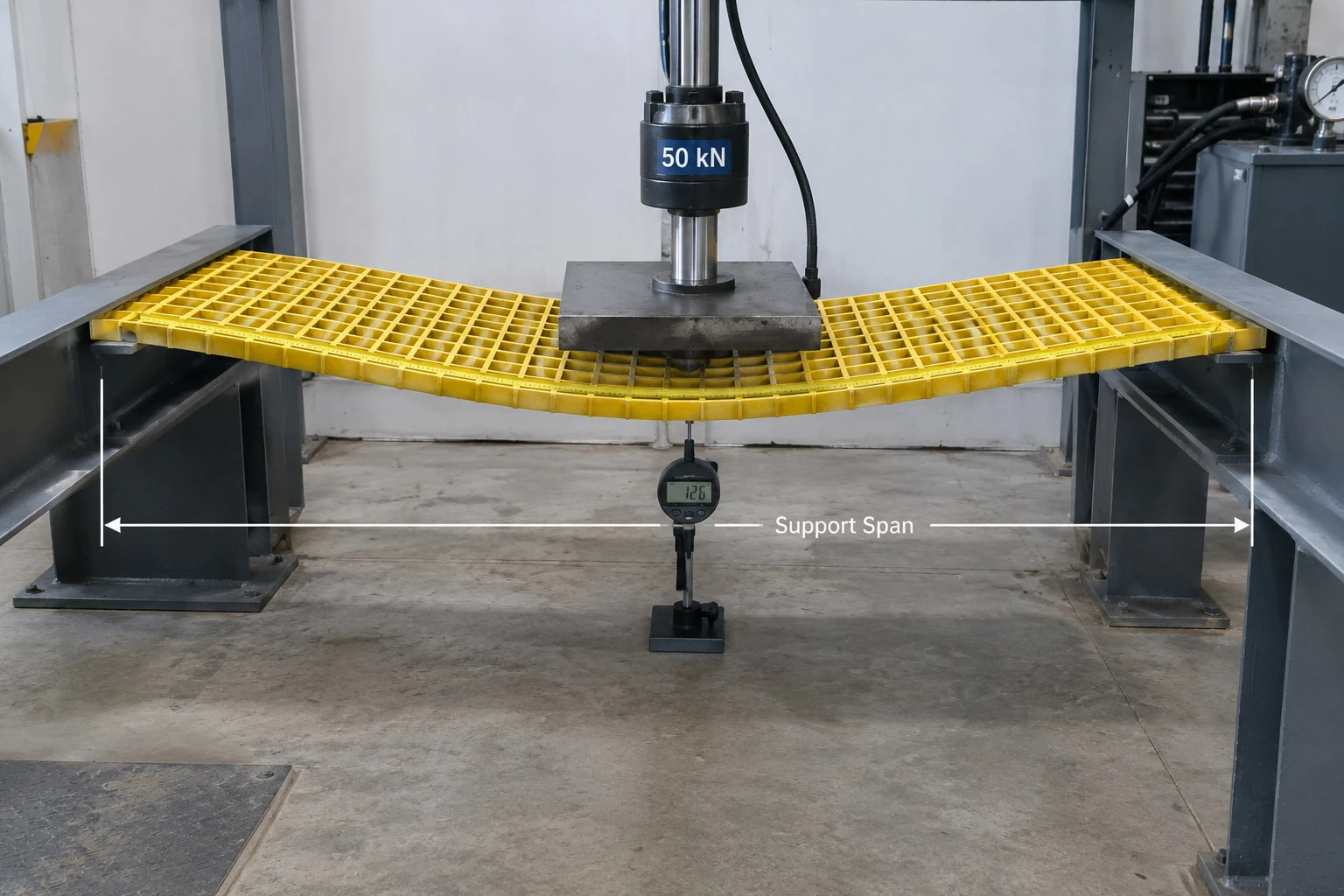
FRP grating deflection should be evaluated according to span, loading conditions and the specified product construction.
Why Does Deflection Matter in FRP Grating Design?
Deflection is primarily a serviceability consideration. Excessive movement may not immediately mean that the grating will fail, but it can create an unstable or uncomfortable walking surface and may indicate that the selected grating specification is not suitable for the actual span.
For industrial applications, excessive deflection can affect:
- Walking comfort and user confidence
- Perceived stability of elevated platforms
- Equipment access areas
- Connections between grating panels and structural supports
- Long-term serviceability of the flooring system
- Performance under concentrated loads
FRP Grating Load Capacity vs. Deflection
Load capacity and deflection describe two different aspects of structural performance. Load capacity is related to the ability of the grating to resist failure, while deflection describes how much the panel deforms under an applied load.
| Design Consideration | What It Indicates | Why It Matters |
|---|---|---|
| Load Capacity | How much load the grating can withstand | Helps verify structural strength |
| Deflection | How much the grating moves under load | Helps verify serviceability and stiffness |
| Span | Distance between supporting members | Strongly affects both load performance and deflection |
| Load Type | Distributed or concentrated loading | Different load patterns produce different structural responses |
How Does Support Span Affect FRP Grating Deflection?
Support span is one of the most important variables affecting grating deflection. As the unsupported distance between structural members increases, the grating generally becomes more flexible under the same loading condition.
This is why the support arrangement should be confirmed before selecting or fabricating FRP grating panels. A grating specification that performs adequately at one span may not provide the same serviceability at a significantly longer span.
For more information on the relationship between structural supports and grating span, see FRP Grating Support Spacing: How to Determine Beam Spacing for Safe Installation.
What Factors Affect FRP Grating Deflection?
1. Support Span
The distance between supports determines the effective span of the grating. Longer spans generally result in greater movement under load, which is why support spacing and deflection should always be evaluated together.
2. Grating Depth and Bearing Bar Geometry
Grating thickness is important, but it should not be treated as the only indicator of stiffness. Bearing bar height, width, spacing and overall structural geometry can influence how a panel responds to loading.
Two panels with similar overall thickness may have different structural performance if their bearing-bar configurations and reinforcement structures are different.
3. Molded vs. Pultruded Construction
Molded and pultruded FRP grating are manufactured using different processes and reinforcement arrangements. Pultruded grating typically uses continuous fiberglass reinforcement oriented primarily along the bearing bars, making it suitable for applications where longer spans and higher directional structural performance are required.
You can compare the two constructions in Pultruded vs. Molded FRP Grating: Which One Is Right for Your Project?.
4. Load Type
Deflection depends not only on the magnitude of the load but also on how the load is applied. A uniformly distributed load spreads across the grating surface, while a concentrated load acts over a smaller area.
Examples of concentrated loads may include:
- A worker standing in a localized area
- Equipment feet
- Maintenance tools or temporary materials
- Small carts or mobile equipment
- Localized loads around process equipment
5. Load-Bearing Direction
FRP grating is directional in its structural behavior. The primary bearing bars should span between the supporting members. If a panel is installed with the bearing bars oriented incorrectly, the expected structural performance may not be achieved.
Installation drawings and manufacturer technical data should therefore be reviewed before panels are cut, positioned and fixed.
What Deflection Limits Are Used for FRP Grating?
Deflection criteria are normally expressed as a ratio of span length, such as L/200, L/250 or L/300, depending on the project specification and application.
Here, L represents the relevant support span. The selected limit should come from the applicable project design criteria, structural standard or engineering specification rather than being assumed to be universal for every FRP grating application.
| Example Criterion | Meaning | Engineering Purpose |
|---|---|---|
| L/100 | Permits greater movement relative to span | May be considered where serviceability requirements are less restrictive |
| L/200 | More restrictive deflection limit | Common engineering reference for serviceability evaluation |
| L/300 | Still more restrictive | May be specified where greater stiffness is required |
Note: The appropriate allowable deflection limit depends on the project specification, applicable design requirements, loading condition and intended use. The examples above should not be treated as a universal design requirement.
How Can Engineers Reduce FRP Grating Deflection?
Option 1: Reduce the Support Span
Adding an intermediate support can reduce the effective span of the grating. This is often one of the most direct ways to improve stiffness without significantly changing the grating panel itself.
Option 2: Select a Different Grating Specification
Where additional structural supports are impractical, the project team may evaluate a different grating depth, bearing-bar configuration or pultruded FRP grating specification.
Product selection should be based on manufacturer load-span data rather than assuming that simply increasing thickness will always produce the required result.
Option 3: Review the Load Distribution
Where concentrated loads are expected, the support arrangement beneath the load may need to be reviewed. Local reinforcement or additional supporting members may be appropriate depending on the project configuration.
FRP Grating Deflection Considerations for Industrial Walkways
Industrial walkways are especially sensitive to excessive deflection because people directly experience movement in the floor. Even when a panel has adequate ultimate strength, excessive flexibility can make a walkway feel unstable.
For pedestrian applications, engineers should consider:
- Expected personnel loading
- Actual support span
- Grating type and bearing-bar configuration
- Allowable serviceability movement
- Concentrated maintenance loads
- Surface slip resistance
- Environmental exposure
Preet Grating supplies FRP walkway grating for industrial access and maintenance applications.
FRP Grating Deflection Checklist for Engineers
| Item | What to Verify |
|---|---|
| Support Span | Actual clear distance between supporting members |
| Design Load | Expected distributed and concentrated loads |
| Grating Type | Molded or pultruded FRP construction |
| Bearing Bars | Height, width, spacing and load-bearing direction |
| Deflection Limit | Project-specific allowable serviceability limit |
| Connections | Suitable clips, fasteners and bearing conditions |
| Openings | Cutouts around pipes, drains, columns and equipment |
| Environmental Conditions | Moisture, chemicals, UV exposure and temperature |
Common Mistakes When Evaluating FRP Grating Deflection
Mistake 1: Looking Only at Maximum Load
A maximum load number without its associated span, loading condition and deflection criterion does not provide enough information for a reliable engineering comparison.
Mistake 2: Assuming Thickness Alone Determines Stiffness
Grating depth is important, but structural geometry, reinforcement, manufacturing method and bearing-bar configuration also influence performance.
Mistake 3: Ignoring Concentrated Loads
A panel designed only around a uniformly distributed load may not perform as expected when heavy localized loads are introduced. Concentrated loading should be evaluated whenever it is part of normal or foreseeable operation.
Mistake 4: Using Generic Deflection Values Without Checking the Project Specification
Deflection criteria can vary according to the application and engineering requirements. Project-specific requirements should take priority over generic assumptions.
How Preet Grating Can Help With FRP Grating Selection
Selecting FRP grating for an industrial project requires more than choosing a panel based on thickness or advertised load capacity. The grating type, support span, load condition, bearing-bar direction and allowable deflection should be evaluated together.
Preet Grating provides molded FRP grating, pultruded FRP grating and FRP structural solutions for industrial platforms, walkways, maintenance areas and corrosive environments.
For projects with specific span and loading requirements, technical information should be reviewed before final product selection. This allows the grating specification and supporting structure to be evaluated as one complete system.
Need Help Checking FRP Grating Deflection?
Send us your grating type, required span, design load and application conditions. Our team can help review the appropriate FRP grating specification for your project.
WhatsApp: +86 138 5147 5666
Email: info@preet.cn
Conclusion: FRP grating selection should consider both load capacity and deflection. Support span, grating construction, bearing-bar geometry, loading conditions and project-specific serviceability requirements all influence how a panel performs in real industrial applications. By evaluating these factors together, engineers can select an FRP grating system that provides the required strength, stiffness and long-term usability.


