

What Are Fiberglass Rectangular Tubes?
Fiberglass rectangular tubes are hollow structural profiles manufactured from fiberglass reinforcement and a thermosetting resin matrix. They are commonly produced through the pultrusion process, which aligns continuous glass fibers along the length of the profile to provide efficient longitudinal structural performance.
Compared with conventional steel or aluminum tubing, fiberglass rectangular tubes offer a combination of low weight, corrosion resistance, electrical insulation and low maintenance. These characteristics make them useful in chemical plants, wastewater facilities, power infrastructure, marine applications and outdoor industrial structures.
However, choosing the correct fiberglass rectangular tube is not simply a matter of selecting the largest available size. Engineers should consider the tube dimensions, wall thickness, span, loading direction, connection method and environmental conditions.
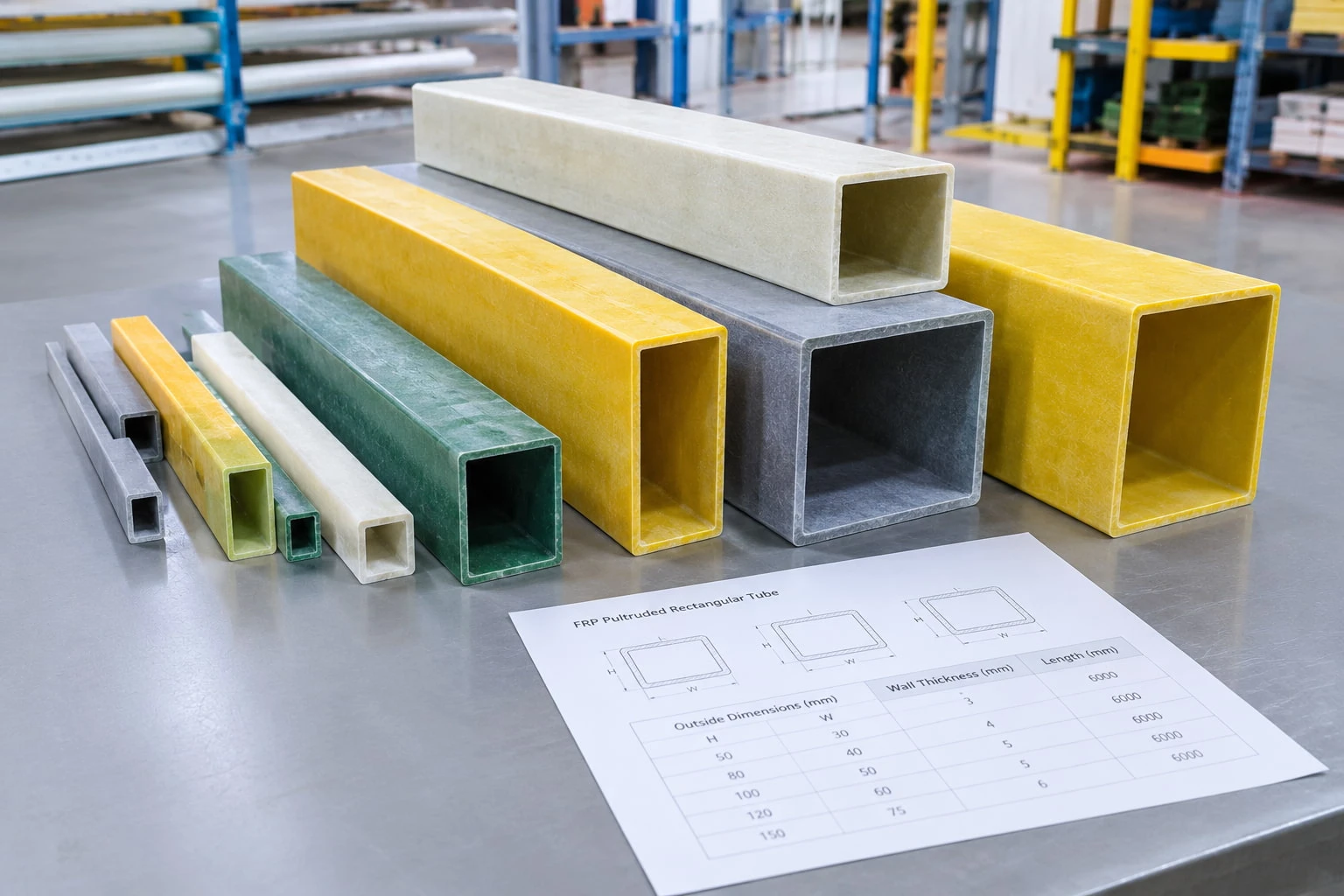
Fiberglass rectangular tubes are available in different dimensions and wall thicknesses for structural and industrial applications.
Why Are Fiberglass Rectangular Tubes Used in Industrial Structures?
FRP rectangular tubes are particularly useful where conventional metal tubing may require frequent corrosion protection or where electrical insulation is important.
Key advantages include:
- High strength-to-weight ratio
- Resistance to rust and many corrosive environments
- Low electrical conductivity
- Low magnetic response
- Lightweight handling and installation
- Low maintenance requirements
- Good dimensional consistency from pultrusion manufacturing
- Availability in different dimensions and resin systems
These characteristics make rectangular FRP profiles suitable for both secondary structures and selected load-bearing applications when properly engineered.
Fiberglass Rectangular Tube Dimensions
Fiberglass rectangular tubes are identified primarily by their outside height, outside width and wall thickness. The internal opening is determined by the outside dimensions and wall thickness.
| Dimension | What It Means | Why It Matters |
|---|---|---|
| Outside Height | Overall vertical dimension of the tube | Influences section depth and bending stiffness |
| Outside Width | Overall horizontal dimension | Affects section geometry and connection area |
| Wall Thickness | Thickness of the FRP tube wall | Affects stiffness, local strength and fastening performance |
| Overall Length | Supplied length of the profile | Affects transportation, cutting and installation |
How Does Wall Thickness Affect FRP Rectangular Tubes?
Wall thickness is an important factor when selecting a fiberglass rectangular tube. Increasing the wall thickness can improve local resistance and provide more material around connection points, but it also increases material usage and weight.
The appropriate wall thickness depends on the actual structural condition.
- Expected bending load
- Compression or tension requirements
- Support span
- Connection method
- Fastener size and location
- Potential impact or local loading
- Required service life
For this reason, engineers should not select a wall thickness based only on visual appearance. Structural calculations or manufacturer engineering data should be used for load-bearing applications.
Fiberglass Rectangular Tube vs Square Tube
Both rectangular and square FRP tubes are hollow pultruded profiles, but their cross-sectional geometry makes them suitable for somewhat different structural conditions.
| Feature | Rectangular Tube | Square Tube |
|---|---|---|
| Cross Section | Two different primary dimensions | Equal width and height |
| Directional Stiffness | Can be optimized for a preferred bending direction | More symmetrical section geometry |
| Typical Use | Frames, supports, beams and equipment structures | Frames, handrails, fencing and general structures |
| Space Efficiency | Useful where one dimension needs to be larger | Useful where a symmetrical profile is preferred |
When the structural load has a clearly defined direction, a rectangular profile may offer a more efficient geometry than a square profile.
How Are Fiberglass Rectangular Tubes Manufactured?
Most structural FRP rectangular tubes are manufactured using pultrusion. Continuous fiberglass reinforcement is impregnated with resin and pulled through a heated forming die.
The process creates a continuous profile with a consistent cross section along its length.
Typical Pultrusion Process
- Continuous fiberglass reinforcement is supplied to the production line.
- Fiberglass is impregnated with the selected resin system.
- The wet reinforcement enters a forming die.
- Heat cures the resin inside the die.
- The finished profile is pulled continuously from the die.
- The profile is cut to the required length.
- Finished tubes are inspected and prepared for shipment.
The continuous reinforcement structure is one reason pultruded FRP profiles provide strong longitudinal mechanical performance.
Where Are Fiberglass Rectangular Tubes Used?
Fiberglass rectangular tubes can be used in a wide range of industrial and infrastructure applications where corrosion resistance, low weight or electrical insulation is valuable.
| Application | Why FRP Rectangular Tubes Are Suitable |
|---|---|
| Chemical Plants | Corrosion resistance in aggressive environments |
| Wastewater Treatment | Resistance to moisture and many corrosive conditions |
| Cable Tray Supports | Lightweight and electrically non-conductive |
| Industrial Fencing | Low maintenance and weather resistance |
| Marine Structures | Useful in wet and salt-exposed environments |
| Equipment Frames | Lightweight structural framework |
| Platforms and Walkways | Can be combined with FRP grating and other pultruded profiles |
Fiberglass Rectangular Tubes for Corrosive Environments
One of the strongest reasons to select FRP rectangular tubing is corrosion resistance. Unlike conventional carbon steel, fiberglass does not develop iron oxide rust when exposed to moisture.
This can make FRP rectangular tubes particularly useful around:
- Acids and alkalis
- Wastewater
- Saltwater
- High-humidity environments
- Chemical processing areas
- Cooling towers
Nevertheless, "corrosion resistant" does not mean universally resistant to every chemical. The resin system should be checked against the actual chemicals, concentration, temperature and exposure duration.
Fiberglass Rectangular Tubes for Outdoor Applications
FRP rectangular tubes can also be used outdoors for structural frames, handrails, fencing, equipment supports and other exposed structures.
Outdoor selection should consider:
- UV exposure
- Temperature range
- Rain and humidity
- Wind loading
- Required mechanical strength
- Connection details
- Expected service life
For continuously exposed installations, the manufacturer's UV and weathering recommendations should be reviewed before specifying the profile.
How to Connect Fiberglass Rectangular Tubes
FRP rectangular tubes can be cut, drilled and mechanically connected using appropriate fasteners and structural connection details.
Common connection approaches include:
| Connection Method | Typical Consideration |
|---|---|
| Bolted Connection | Simple installation and convenient field assembly |
| Mechanical Bracket | Useful for frames and equipment supports |
| Adhesive Bonding | Requires compatible adhesive and controlled surface preparation |
| Hybrid Connection | Combines mechanical fasteners with other joining methods when required |
When drilling FRP profiles, holes should be positioned and sized appropriately to reduce the risk of local damage. Structural connections should be designed for the expected loads rather than treated as simple hardware connections.
How to Select the Right Fiberglass Rectangular Tube
A practical selection process should start with the application requirements rather than the available profile sizes.
- Define the function. Determine whether the tube is being used as a beam, column, frame member, brace, handrail or support.
- Determine the loading condition. Identify dead load, live load, wind load, equipment load and any concentrated loading.
- Determine the span. The distance between supports has a major effect on bending and deflection.
- Select the section geometry. Choose a rectangular or square section according to the required structural direction and available installation space.
- Select wall thickness. Evaluate stiffness, local loading and connection requirements.
- Check the environment. Consider chemicals, moisture, saltwater, UV exposure and operating temperature.
- Review the connection. Make sure the selected profile can accommodate the required fasteners and connection details.
- Confirm manufacturer data. For structural applications, verify mechanical properties and design information with the manufacturer.
Fiberglass Rectangular Tube Selection Checklist
| Selection Item | What to Confirm |
|---|---|
| Profile Type | Rectangular or square tube |
| Outside Dimensions | Required height and width |
| Wall Thickness | Required stiffness and local strength |
| Length | Standard or customized profile length |
| Load | Bending, compression, tension and concentrated loads |
| Span | Distance between structural supports |
| Environment | Chemical, marine, outdoor or indoor conditions |
| Connection | Bolted, bracketed or other joining method |
Fiberglass Rectangular Tube vs Steel Tube
| Property | Fiberglass Rectangular Tube | Steel Tube |
|---|---|---|
| Weight | Generally lightweight | Generally heavier |
| Corrosion | Excellent resistance to many corrosive environments | Requires appropriate corrosion protection |
| Electrical Conductivity | Non-conductive | Conductive |
| Maintenance | Generally low maintenance | May require coating maintenance |
| Fabrication | Can be cut and drilled with suitable tools | Commonly welded, cut and drilled |
Preet Fiberglass Rectangular Tubes
Preet supplies pultruded fiberglass rectangular tubes for structural frames, equipment supports, cable tray systems, fencing, platforms and other industrial applications.
The available profile range can be customized according to project requirements, including dimensions, wall thickness, length, color and resin selection.
View the product: Fiberglass Rectangular Tube
You can also compare the related: FRP Pultruded Rectangular Tube for structural and industrial applications.
Need a Custom Fiberglass Rectangular Tube?
Send us your required dimensions, wall thickness, length, loading conditions and application environment. Our team can help evaluate a suitable FRP rectangular tube specification.
WhatsApp: +86 138 5147 5666
Email: info@preet.cn
Conclusion: Fiberglass rectangular tubes provide a practical combination of structural performance, low weight, corrosion resistance and electrical insulation. The correct profile should be selected according to dimensions, wall thickness, span, loading, connection requirements and environmental exposure. For demanding structural applications, manufacturer engineering data should always be reviewed before final specification.


