

Can FRP Grating Be Used Outdoors?
Yes. FRP grating is widely used for outdoor walkways, platforms, rooftops, cooling towers, wastewater facilities, marine areas and industrial access structures. However, outdoor performance depends on more than the fiberglass reinforcement itself.
Outdoor FRP grating is continuously exposed to ultraviolet radiation, rain, moisture, temperature changes, airborne contaminants and, in coastal locations, salt-laden air. The resin system, surface treatment, color, installation details and actual operating environment all influence long-term performance.
For this reason, selecting FRP grating for an outdoor project should involve an environmental assessment rather than simply choosing a standard indoor specification.
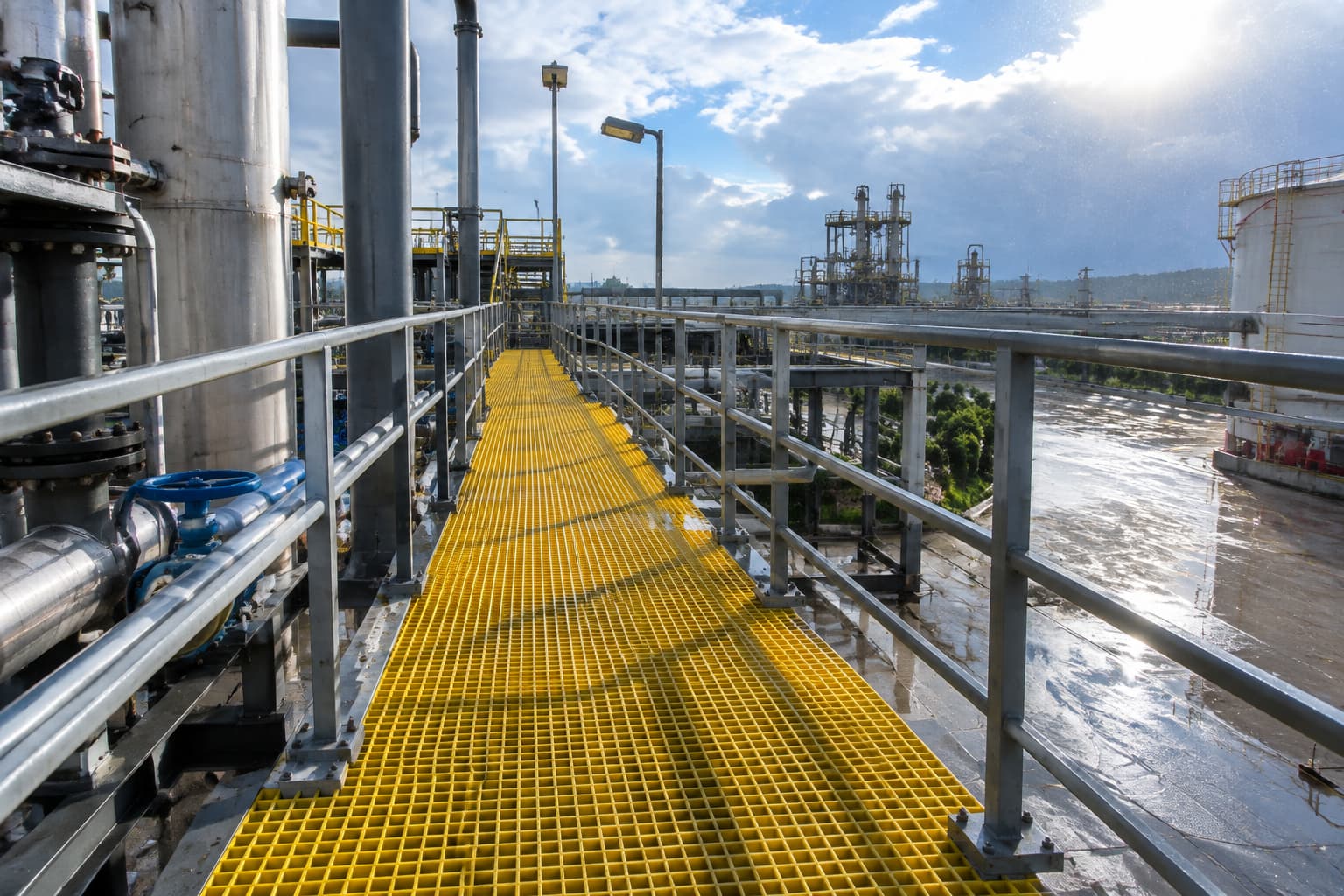
Outdoor FRP grating must withstand sunlight, moisture and changing environmental conditions throughout its service life.
What Environmental Conditions Affect Outdoor FRP Grating?
Outdoor grating is exposed to several environmental factors at the same time. The severity depends on the geographic location, installation height, surrounding industry and whether the grating is exposed or partially protected.
| Environmental Factor | Potential Effect | Design Consideration |
|---|---|---|
| UV Radiation | Surface aging, color change or resin degradation over time | UV-resistant resin or surface protection |
| Rain and Moisture | Continuous wetting and drying cycles | Appropriate resin and drainage design |
| Temperature Changes | Thermal expansion and contraction | Allow for movement and correct installation |
| Salt Spray | Long-term exposure to chloride-rich moisture | Marine-grade resin and suitable fasteners |
| Industrial Chemicals | Chemical attack on the resin system | Check chemical compatibility before specification |
How Does UV Exposure Affect FRP Grating?
Ultraviolet radiation is one of the most important factors to consider when FRP grating is installed in direct sunlight.
Long-term UV exposure can affect the outer resin surface. Depending on the formulation and exposure conditions, visible changes may include surface chalking, fading or changes in appearance.
This does not mean that every visible color change represents structural failure. Engineers should distinguish between cosmetic surface weathering and actual degradation of the composite structure.
For critical outdoor installations, the manufacturer should be asked to provide information about the resin system, UV stabilization and expected environmental performance.
Does FRP Grating Need UV Protection?
For continuously exposed outdoor installations, UV-resistant materials or appropriate surface protection should be considered.
UV protection can be incorporated into the material formulation or surface system depending on the product design. The correct approach should be confirmed with the manufacturer because different resin systems and surface finishes have different weathering characteristics.
Outdoor applications that deserve particular attention include:
- Rooftop access walkways
- Solar power plant maintenance platforms
- Cooling tower platforms
- Water treatment facilities
- Marine docks and decks
- Offshore access platforms
- Outdoor chemical plant platforms
- Industrial equipment access areas
How Does Resin Selection Affect Outdoor Durability?
The resin matrix surrounds the fiberglass reinforcement and plays an important role in environmental resistance. Different resin systems should be evaluated according to the actual exposure conditions.
| Resin Consideration | Outdoor Selection Consideration |
|---|---|
| Polyester | Suitable for many general industrial outdoor applications when the environment is properly evaluated |
| Isophthalic Polyester | Can provide enhanced resistance for demanding industrial environments |
| Vinyl Ester | Often selected where stronger chemical and corrosion resistance is required |
| Specialty / Fire-Retardant Systems | Selected when project fire, smoke or other specialized requirements apply |
Resin selection should be based on the complete exposure profile rather than simply choosing the most expensive material.
For a more detailed comparison, see: How to Choose the Right FRP Grating Resin: Polyester vs Vinyl Ester vs Phenolic .
Outdoor FRP Grating in Coastal and Marine Environments
Coastal and marine installations are particularly demanding because the grating may be exposed to salt spray, high humidity, direct sunlight and repeated wet-dry cycles.
Typical applications include:
- Marine walkways
- Dock platforms
- Offshore platforms
- Ship access areas
- Desalination facilities
- Seawater treatment systems
In these environments, the resin system should be selected for the expected chemical and moisture exposure. Fasteners and supporting structures should also be evaluated because a corrosion-resistant FRP panel does not eliminate corrosion risks from unsuitable metal components.
Outdoor FRP Grating and Temperature Changes
Outdoor structures experience daily and seasonal temperature changes. The grating and supporting structure can therefore experience thermal movement.
For large installations, engineers should consider:
- Panel dimensions
- Joint locations
- Fastener arrangement
- Clearance around fixed structures
- Support configuration
- Local temperature range
Panels should not be installed so tightly that normal thermal movement is unnecessarily restricted. Installation details should follow the manufacturer's recommendations for the specific grating system.
How Does Outdoor Exposure Affect FRP Grating Maintenance?
One of the advantages of FRP grating is its relatively low maintenance requirement compared with painted or galvanized steel in many corrosive environments. However, low maintenance does not mean no inspection is required.
Outdoor FRP grating should be periodically checked for:
| Inspection Item | What to Check |
|---|---|
| Surface | Cracks, severe wear, delamination or abnormal surface damage |
| Bearing Bars | Damage, deformation or loss of structural integrity |
| Fasteners | Loosening, corrosion or missing clips |
| Support Structure | Corrosion, movement or structural damage |
| Slip Surface | Wear or contamination affecting traction |
Outdoor FRP Grating for Solar Power Plants
Solar power facilities are a good example of an outdoor application where several factors must be considered simultaneously. Maintenance walkways may experience direct sunlight, rain, dust, temperature cycling and regular pedestrian traffic.
FRP grating can be used for maintenance access between photovoltaic equipment, around inverters and transformers, and in other areas where corrosion resistance, low weight and electrical insulation are important.
However, solar projects should still specify the required load capacity, support span, surface traction and outdoor durability instead of treating all FRP grating as interchangeable.
Related application: FRP Grating Walkways for Solar Power Plants
Outdoor FRP Grating vs Steel Grating
| Factor | FRP Grating | Steel Grating |
|---|---|---|
| Rust | Does not rust like steel | Requires corrosion protection in many outdoor environments |
| Weight | Generally lightweight | Heavier |
| Electrical Conductivity | Non-conductive | Conductive |
| UV Exposure | Requires appropriate UV/weathering consideration | Coatings may require maintenance |
| Maintenance | Typically low maintenance in suitable environments | May require coating inspection and maintenance |
How to Select FRP Grating for Outdoor Applications
A practical outdoor FRP grating specification should include both structural and environmental requirements.
- Define the application. Identify whether the grating is used for a walkway, platform, stair, trench cover or equipment access area.
- Calculate the required load. Consider personnel, maintenance equipment and any concentrated loads.
- Determine the support span. Use the actual distance between structural supports when selecting the grating.
- Evaluate UV exposure. Identify whether the panels will receive direct sunlight throughout the service life.
- Evaluate chemical exposure. Consider chemicals, saltwater, cleaning agents and process fluids.
- Select the appropriate resin system. Match the resin to the environmental and project requirements.
- Select the surface finish. Wet outdoor environments may require an appropriate anti-slip surface.
- Check fastening and support details. The complete installation system must be suitable for outdoor conditions.
Common Mistakes When Using FRP Grating Outdoors
Mistake 1: Assuming All FRP Grating Has the Same UV Performance
Different resin formulations and surface systems can have different weathering characteristics. Always confirm the manufacturer's specification for the intended environment.
Mistake 2: Choosing Grating Based Only on Corrosion Resistance
Outdoor durability also involves UV exposure, temperature changes, mechanical loading, slip resistance and installation conditions.
Mistake 3: Ignoring Fasteners
Even when the FRP panel itself is highly corrosion resistant, unsuitable metal clips or bolts can become a weak point in a coastal or chemical environment.
Mistake 4: Treating Surface Weathering as Automatic Structural Failure
Color fading or surface chalking should be evaluated carefully. Visual weathering and structural damage are not necessarily the same condition.
Mistake 5: Forgetting the Support Structure
FRP grating performance depends on the complete system. Steel beams, FRP supports, clips and panel layout should all be evaluated as part of the installation.
Outdoor FRP Grating Selection Checklist
| Requirement | Check Before Ordering |
|---|---|
| UV Exposure | Direct sunlight, partial shade or protected installation |
| Weather | Rain, humidity, temperature and seasonal conditions |
| Salt Exposure | Coastal, marine or offshore environment |
| Chemical Exposure | Chemical type and concentration |
| Load | Uniform and concentrated loads |
| Support Span | Actual distance between supports |
| Surface | Required slip resistance for wet conditions |
| Fasteners | Material compatibility with the environment |
Why Choose Preet Grating for Outdoor FRP Applications?
Preet Grating provides fiberglass reinforced plastic grating for industrial platforms, walkways, wastewater facilities, marine environments, energy projects and other demanding applications.
The selection of an outdoor FRP grating system should be based on the complete project condition, including load requirements, support span, resin compatibility, UV exposure, surface requirements and installation details.
For product information, visit the Preet FRP Grating product range .
Need Help Selecting Outdoor FRP Grating?
Send us your project location, support span, expected loads, environmental conditions and required panel dimensions. Our team can help recommend a suitable FRP grating specification.
WhatsApp: +86 138 5147 5666
Email: info@preet.cn
Conclusion: FRP grating can provide reliable long-term performance in many outdoor environments when the material is correctly specified and installed. UV exposure, weathering, temperature changes, moisture, salt spray, chemical exposure, loading and fastening details should all be considered before selecting the final grating system.


