

FRP Channel vs Steel Channel: Why Material Selection Matters
FRP channel and steel channel are both widely used as structural members for industrial frames, supports, cable systems, equipment structures and access platforms. However, they behave very differently when exposed to corrosion, moisture, chemicals, electrical hazards and outdoor conditions.
Steel remains a strong and familiar structural material, but it normally requires an appropriate coating, galvanizing system or other corrosion protection when used in aggressive environments. Pultruded FRP channel, by contrast, combines continuous fiberglass reinforcement with a resin matrix to provide corrosion resistance, low weight and electrical insulation.
The better material is therefore not determined by strength alone. Engineers should evaluate the load condition, span, environment, weight, maintenance requirements, connection method and required service life before selecting an FRP or steel channel.
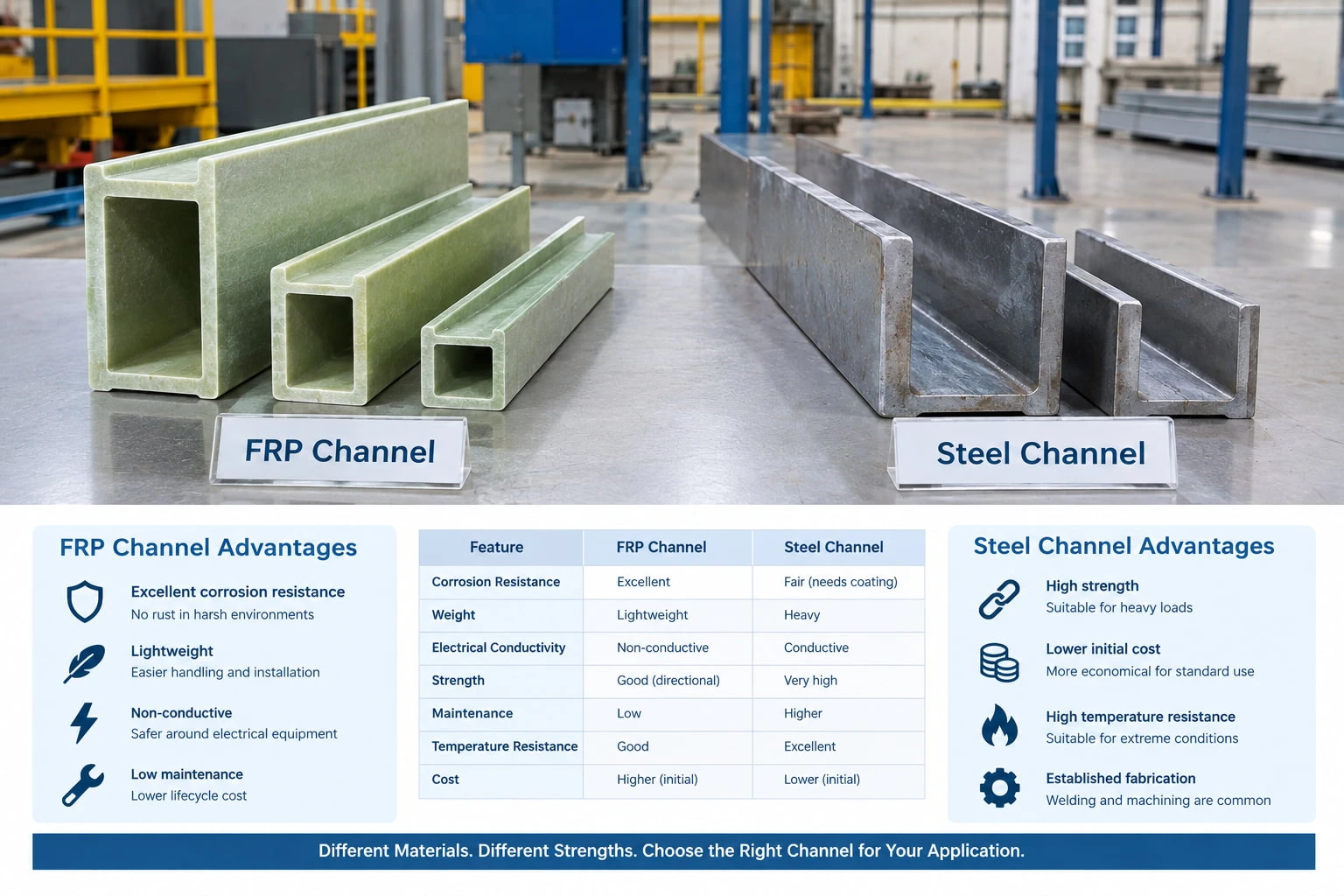
What Is an FRP Channel?
FRP channel, also called a fiberglass U-channel or pultruded fiberglass channel, is a structural profile manufactured from fiberglass reinforcement and a thermosetting resin system.
During pultrusion, continuous glass fibers are impregnated with resin and pulled through a heated forming die. This creates a consistent channel-shaped profile with fibers primarily aligned along the length of the member.
FRP channels are commonly used for:
- Cable tray and cable support systems
- Equipment frames and supports
- Walkway and platform structures
- Ladder components
- Handrail and guardrail systems
- Water and wastewater treatment structures
- Chemical processing facilities
- Marine and coastal structures
- Electrical and power infrastructure
Preet's current FRP Channel range includes pultruded fiberglass profiles with different dimensions, wall thicknesses and surface options for industrial applications. View the FRP Channel product page.
FRP Channel vs Steel Channel: Key Differences
| Property | FRP Channel | Steel Channel |
|---|---|---|
| Corrosion Resistance | Excellent resistance to many corrosive environments | Requires suitable corrosion protection in aggressive environments |
| Weight | Lightweight and easier to handle | Generally heavier |
| Electrical Conductivity | Electrically non-conductive | Conductive |
| Maintenance | Generally low maintenance | May require coating inspection and corrosion maintenance |
| Fabrication | Can be cut and drilled with appropriate tools | Can be welded, cut and drilled |
| Chemical Environment | Suitable when the resin system is correctly selected | May require specialized coatings or higher-grade alloys |
| Magnetic Properties | Low magnetic response | Typically magnetic |
1. Corrosion Resistance: Where FRP Channel Has a Major Advantage
Corrosion is one of the most important factors when selecting structural channels for industrial facilities.
Carbon steel can corrode when exposed to water, salt, chemicals and humid environments. Protective systems such as galvanizing, painting or specialized coatings can reduce corrosion, but these systems require proper specification, application and maintenance.
FRP channel does not contain steel and therefore does not develop conventional iron oxide rust. This makes pultruded fiberglass channel particularly attractive for environments such as:
- Chemical processing plants
- Wastewater treatment facilities
- Cooling towers
- Marine and coastal installations
- Water treatment systems
- Salt-laden outdoor environments
- Industrial areas with frequent washdown
However, FRP should not be described as universally resistant to every chemical. Resin selection should be based on the actual chemical, concentration, temperature and exposure duration.
For severe chemical environments, engineers should confirm resin compatibility and manufacturer technical data before final specification.
2. Weight and Installation Efficiency
One of the practical advantages of FRP channel is its relatively low weight compared with conventional steel structural members.
A lighter profile can simplify transportation, lifting, positioning and field installation. This is particularly useful when structural members must be installed in difficult-to-access areas or when minimizing the load placed on an existing structure is important.
| Installation Factor | FRP Channel | Steel Channel |
|---|---|---|
| Manual Handling | Generally easier for many profile sizes | More difficult as member weight increases |
| Field Cutting | Can be cut with suitable abrasive or carbide tools | Requires conventional metal-cutting equipment |
| Field Welding | Not required for typical mechanical connections | Often used for structural fabrication |
| Site Modification | Cutting and drilling are practical with proper tools | Well established but generally more equipment-intensive |
3. Strength and Structural Design
Choosing FRP instead of steel does not mean ignoring structural calculations. Both materials must be evaluated according to the actual load and support conditions.
For an FRP channel, engineers should consider:
- Section dimensions
- Wall thickness
- Span between supports
- Load magnitude and load distribution
- Bending direction
- Deflection limits
- Compression or tension requirements
- Connection details
- Temperature and environmental exposure
FRP's mechanical properties are also direction-dependent because pultrusion places a large proportion of the continuous reinforcement along the longitudinal direction.
Therefore, an FRP channel should not be selected simply by comparing its nominal dimensions with a steel channel. Engineers should compare the actual section properties and allowable design performance for the intended application.
4. Electrical Insulation: An Important FRP Advantage
Steel is electrically conductive, while properly manufactured FRP profiles are electrically non-conductive. This characteristic can be valuable around electrical equipment, substations, cable systems and other applications where electrical isolation is desirable.
FRP channel can therefore be considered for:
- Cable tray supports
- Electrical equipment frames
- Substation structures
- Instrument supports
- Telecommunications infrastructure
- Electrical access systems
Electrical performance should still be evaluated according to the actual project requirements, because the surrounding hardware, fasteners and installation system may contain conductive materials.
5. Maintenance and Lifecycle Considerations
The initial purchase price is only one part of the total cost of a structural channel.
Steel structures in corrosive environments may require periodic inspection, coating repair, repainting, galvanizing maintenance or replacement of damaged components. These activities can increase labor costs and operational downtime.
FRP channel generally requires less corrosion-related maintenance. Its lifecycle advantages can become more significant when the structure is difficult to access or when maintenance activities require production shutdowns.
| Lifecycle Factor | FRP Channel | Steel Channel |
|---|---|---|
| Rust Repair | Not applicable to the FRP profile itself | Potential requirement depending on environment and protection system |
| Painting | Generally not required for corrosion protection | May be required depending on coating system |
| Inspection | Still requires structural inspection | Structural and corrosion inspection may both be required |
| Downtime Risk | Potentially lower in corrosive environments | Can increase when corrosion repairs are required |
6. When Should Engineers Choose FRP Channel Instead of Steel?
FRP channel is particularly attractive when several of the following conditions apply:
- The structure is exposed to chemicals or saltwater.
- Long-term corrosion resistance is a priority.
- Low structural weight is important.
- Electrical insulation is beneficial.
- Field installation needs to be simple and lightweight.
- Maintenance access is difficult or expensive.
- The structure is located outdoors or in a high-humidity environment.
- The project requires a non-metallic structural profile.
Steel may remain the better option when extremely high structural loads, high-temperature service, established welded fabrication or specific structural-code requirements dominate the project.
The correct decision should therefore be based on engineering requirements rather than assuming that one material is always superior.
7. FRP Channel vs Steel Channel: Practical Selection Guide
| Project Condition | Preferred Starting Point | Reason |
|---|---|---|
| Chemical exposure | FRP Channel | Corrosion resistance and lower maintenance potential |
| Wastewater treatment | FRP Channel | Moisture and corrosion resistance |
| Electrical infrastructure | FRP Channel | Non-conductive structural profile |
| Marine/coastal structure | FRP Channel | Resistance to moisture and salt exposure |
| Very high structural loads | Evaluate both | Section properties and engineering calculations are critical |
| Conventional welded steel frame | Steel Channel | Established fabrication and welding methods |
| Corrosive + lightweight structure | FRP Channel | Combines corrosion resistance with easier handling |
8. How to Specify an FRP Channel
A professional FRP channel specification should include more than the channel name. Before requesting a quotation, provide the supplier with the information needed to evaluate the profile properly.
- Channel dimensions: Specify the required height, width and wall thickness.
- Required length: Indicate standard or customized profile lengths.
- Loading: Provide the expected distributed, concentrated, bending, compression or other loads.
- Support span: State the distance between structural supports.
- Environment: Identify chemicals, moisture, saltwater, UV exposure and operating temperature.
- Resin system: Confirm the resin type according to environmental requirements.
- Surface: Specify smooth, grit, painted or other required finishes.
- Connection: Provide information about bolts, brackets, fasteners or other connection requirements.
Preet's FRP Channel product information includes examples such as 50 × 30 mm, 100 × 50 mm and 150 × 75 mm profiles, with different wall thicknesses and surface options. Custom dimensions, colors, surface treatments and resin systems are also available according to project requirements.
9. FRP Channel and Other Pultruded Profiles
FRP channel is only one type of pultruded structural profile. Depending on the required load path and geometry, engineers may also consider rectangular tubes, square tubes, angles, I-beams and other custom sections.
If the structure requires a closed cross-section, a fiberglass rectangular tube may be more appropriate than an open channel. If easy access around the profile or a U-shaped support is important, an FRP channel can be a more practical choice.
For background on the broader range of pultruded structural profiles, see Understanding FRP Pultrusion Profiles.
You can also review the Fiberglass Rectangular Tubes selection guide when comparing open and closed FRP structural sections.
10. Final Decision: FRP Channel or Steel Channel?
FRP channel is often the stronger material choice for corrosive industrial structures where corrosion resistance, lightweight construction, electrical insulation and low maintenance are important.
Steel channel remains highly competitive for conventional structural applications where high loads, welded fabrication, high-temperature service or established steel design practices are the primary considerations.
The best engineering decision is therefore not simply FRP versus steel. It is the material that provides the required structural performance while also meeting the project's environmental, installation and lifecycle requirements.
For corrosive environments, especially chemical plants, wastewater facilities, marine structures and electrical infrastructure, pultruded FRP channel deserves consideration early in the material-selection process.
FRP Channel Selection Support
Need help selecting an FRP channel for your project? Send us the required channel dimensions, wall thickness, span, loading conditions, connection method and operating environment. Our team can help evaluate a suitable fiberglass structural profile.
WhatsApp: +86 138 5147 5666
Email: info@preet.cn


