

What Is an FRP I Beam?
An FRP I beam, also called a fiberglass I beam or pultruded fiberglass I-beam, is a structural profile manufactured from fiberglass reinforcement and resin through a pultrusion process. Its I-shaped cross-section is designed to provide structural stiffness while keeping the profile relatively lightweight.
FRP I beams are used where engineers need a combination of structural performance, corrosion resistance, electrical insulation and reduced maintenance. Typical applications include industrial support structures, platforms, walkways, equipment frames, cooling tower structures and other environments where conventional steel profiles may be exposed to corrosion.
When specifying an FRP I beam, engineers should evaluate the complete structural condition rather than selecting a profile based only on its nominal height.
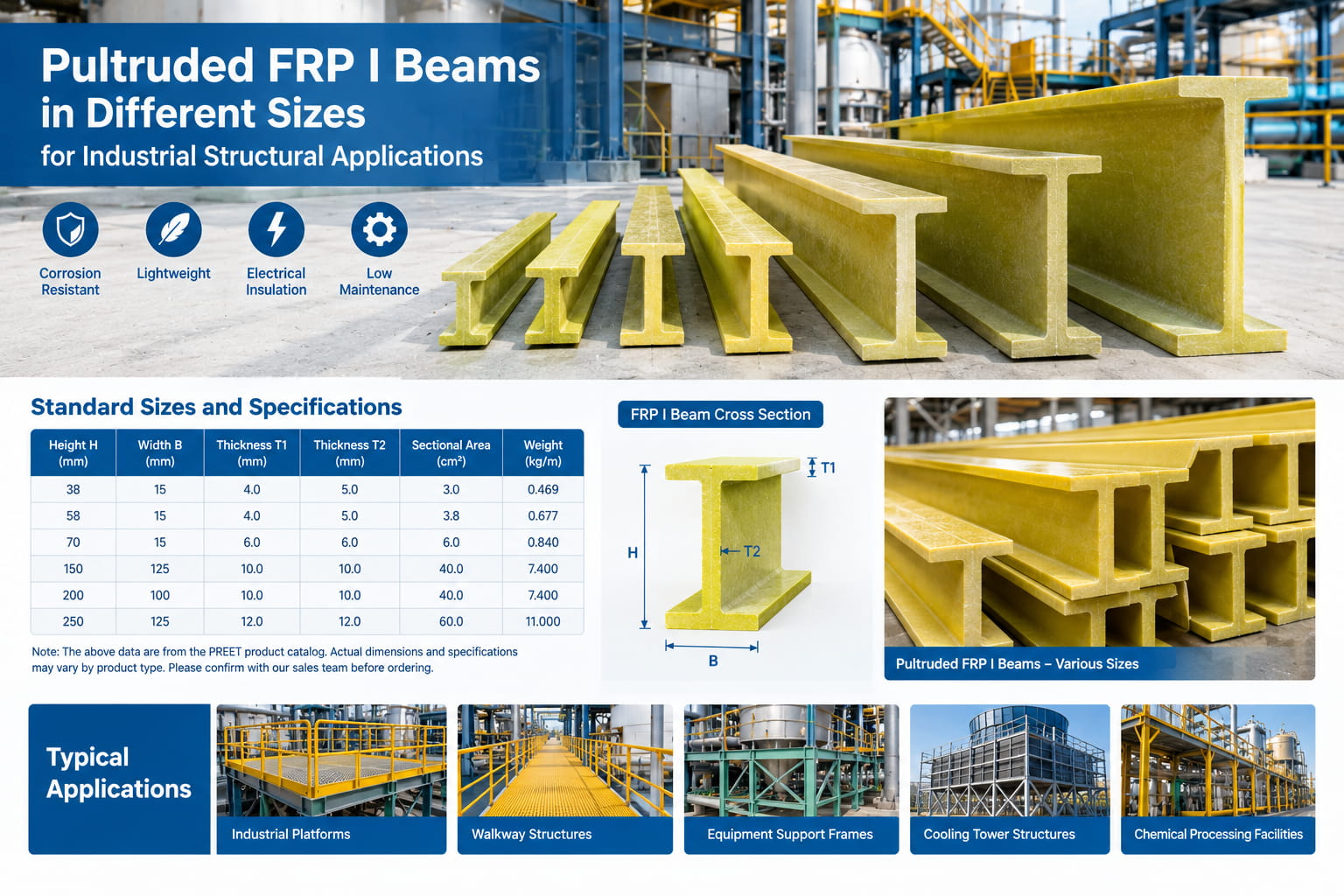
Pultruded FRP I beams are available in different section heights and dimensions for corrosion-resistant structural applications.
FRP I Beam Dimensions and Specifications
Preet's product catalog lists several fiberglass I-beam profiles with different heights, widths, thicknesses, sectional areas and weights. The following table uses the dimensions and material data provided in the company catalog.
| Height H (mm) | Width B (mm) | Thickness T1 (mm) | Thickness T2 (mm) | Sectional Area (cm²) | Weight (kg/m) |
|---|---|---|---|---|---|
| 38 | 15 | 4.0 | 5.0 | 3.0 | 0.469 |
| 58 | 15 | 4.0 | 5.0 | 3.8 | 0.677 |
| 70 | 15 | 6.0 | 6.0 | 6.0 | 0.840 |
| 150 | 125 | 10.0 | 10.0 | 40.0 | 7.400 |
| 200 | 100 | 10.0 | 10.0 | 40.0 | 7.400 |
| 250 | 125 | 12.0 | 12.0 | 60.0 | 11.000 |
Source: Preet Composite Material Co., Ltd. product catalog. Always confirm the latest technical drawing and quotation before placing an order.
What Do H, B, T1 and T2 Mean on an FRP I Beam?
FRP I beam drawings normally identify several important dimensional parameters. Understanding these dimensions makes it easier for engineers and purchasing teams to compare different profiles.
| Parameter | Meaning | Why It Matters |
|---|---|---|
| H | Overall section height | Defines the overall depth of the I-beam profile. |
| B | Overall section width | Affects the flange geometry and installation interface. |
| T1 | Profile thickness dimension | Forms part of the section geometry and structural design. |
| T2 | Profile thickness dimension | Should be checked against the manufacturer's drawing when designing connections. |
| Sectional area | Cross-sectional area of the profile | Useful for engineering calculations and material comparison. |
| Weight kg/m | Profile weight per meter | Important for transportation, handling and overall structural dead load. |
Why Use Pultruded FRP I Beams?
Pultruded FRP profiles are manufactured by continuously pulling fiberglass reinforcement through a resin system and forming die. The resulting profile has a consistent cross-section along its length.
Compared with conventional metallic structural profiles, FRP I beams can be advantageous when the project requires corrosion resistance, electrical insulation and lower handling weight.
- Corrosion resistance: FRP is suitable for many aggressive industrial environments where steel corrosion is a concern.
- Lightweight construction: Lower profile weight can simplify transportation and on-site handling.
- Electrical insulation: FRP is electrically non-conductive compared with conventional metal structural sections.
- Low maintenance: FRP does not require the same corrosion-protection approach as conventional carbon-steel profiles.
- Consistent profile geometry: Pultrusion produces continuous profiles with a controlled cross-section.
FRP I Beam vs. Other Pultruded Profiles
An I beam is only one option within a larger family of pultruded FRP structural profiles. The appropriate section depends on the required geometry, connection method, available space and structural design.
| Profile | Typical selection consideration |
|---|---|
| FRP I Beam | Useful where an I-shaped structural section is required. |
| FRP C Channel | Useful for frames, supports, edge members and connection-friendly structural assemblies. |
| FRP Square Tube | Useful for enclosed-section frames, supports and structural assemblies. |
| FRP Rectangular Tube | Useful where a rectangular closed section better fits the required geometry. |
For more information, see Preet's FRP Pultrusion Profiles, FRP C Channel, FRP Square Tube and Fiberglass Rectangular Tube products.
How to Select the Right FRP I Beam Size
Choosing an FRP I beam should start with the structural requirement rather than simply selecting the largest available profile.
- Define the application: identify whether the profile will be used as a beam, frame member, equipment support, platform structure or another component.
- Determine the design load: establish the expected static, live, equipment or maintenance load.
- Confirm the span: unsupported span has a major influence on structural behavior and deflection.
- Evaluate the section: compare profile height, width, thickness and sectional area with the engineering requirement.
- Check deflection: strength alone is not enough. Serviceability and allowable deflection should also be considered.
- Review connections: confirm that the selected profile can accommodate the proposed bolts, brackets, plates or other connection details.
- Consider the environment: review chemical exposure, moisture, temperature, UV exposure and other operating conditions.
For structural applications, the final FRP I beam selection should be based on the actual project load, span, support conditions and manufacturer's technical data. A profile that is suitable for one span or loading condition should not automatically be assumed suitable for another.
FRP I Beam Applications
FRP I beams can be incorporated into a range of industrial composite structures where corrosion resistance and lightweight structural components are important.
- Industrial platforms and access structures
- Equipment support frames
- Cooling tower structures
- Corrosion-resistant walkways
- Plant maintenance structures
- Structural frames in chemical environments
- Marine and coastal structures
- Other customized FRP structural assemblies
FRP profiles are also used together with FRP grating to build complete corrosion-resistant platforms and walkways. The profile selection and grating selection should therefore be coordinated rather than treated as two independent products.
FRP I Beam Weight and Material Handling
Weight per meter is an important practical parameter when planning transportation and installation. The catalog-listed FRP I-beam profiles range from 0.469 kg/m to 11.000 kg/m across the listed sections.
For example, the 38 mm-high profile is listed at 0.469 kg/m, while the 250 mm-high profile is listed at 11.000 kg/m. This illustrates why the selected profile should be matched to the actual structural requirement instead of using one generic FRP beam size for every application.
For larger structural assemblies, the profile weight should also be included when engineers calculate the dead load of the complete structure.
What Information Should You Provide When Ordering FRP I Beams?
For a project quotation or technical evaluation, providing complete engineering information helps the manufacturer recommend an appropriate profile more efficiently.
| Information | Recommended details |
|---|---|
| Profile | FRP I beam or required cross-section |
| Dimensions | Required H, B, T1 and T2 or reference drawing |
| Length | Required profile length |
| Load | Design load and load distribution |
| Span | Unsupported span and support arrangement |
| Environment | Chemicals, moisture, outdoor exposure, temperature and other relevant conditions |
| Quantity | Required quantity and delivery length |
Conclusion
FRP I beams provide a practical structural profile option for projects that require lightweight, corrosion-resistant and electrically insulating components. Preet's product catalog lists I-beam sections with heights from 38 mm to 250 mm, together with corresponding widths, thicknesses, sectional areas and weights.
The correct FRP I beam should not be selected from height or weight alone. Engineers should evaluate span, design load, deflection, support conditions, connection details and operating environment together with the manufacturer's technical data.
If you are comparing FRP I beams with C channels, square tubes or rectangular tubes, the best section depends on the required structural geometry and connection method rather than simply choosing the profile with the largest dimensions.
Need an FRP I beam for your project? Send us the required dimensions, length, span, design load and application environment so our team can evaluate the appropriate pultruded FRP profile.
Contact us on WhatsApp: +86 138 5147 5666
Email: info@preet.cn


