

Composite Grating vs Plastic Grating: What Is the Difference?
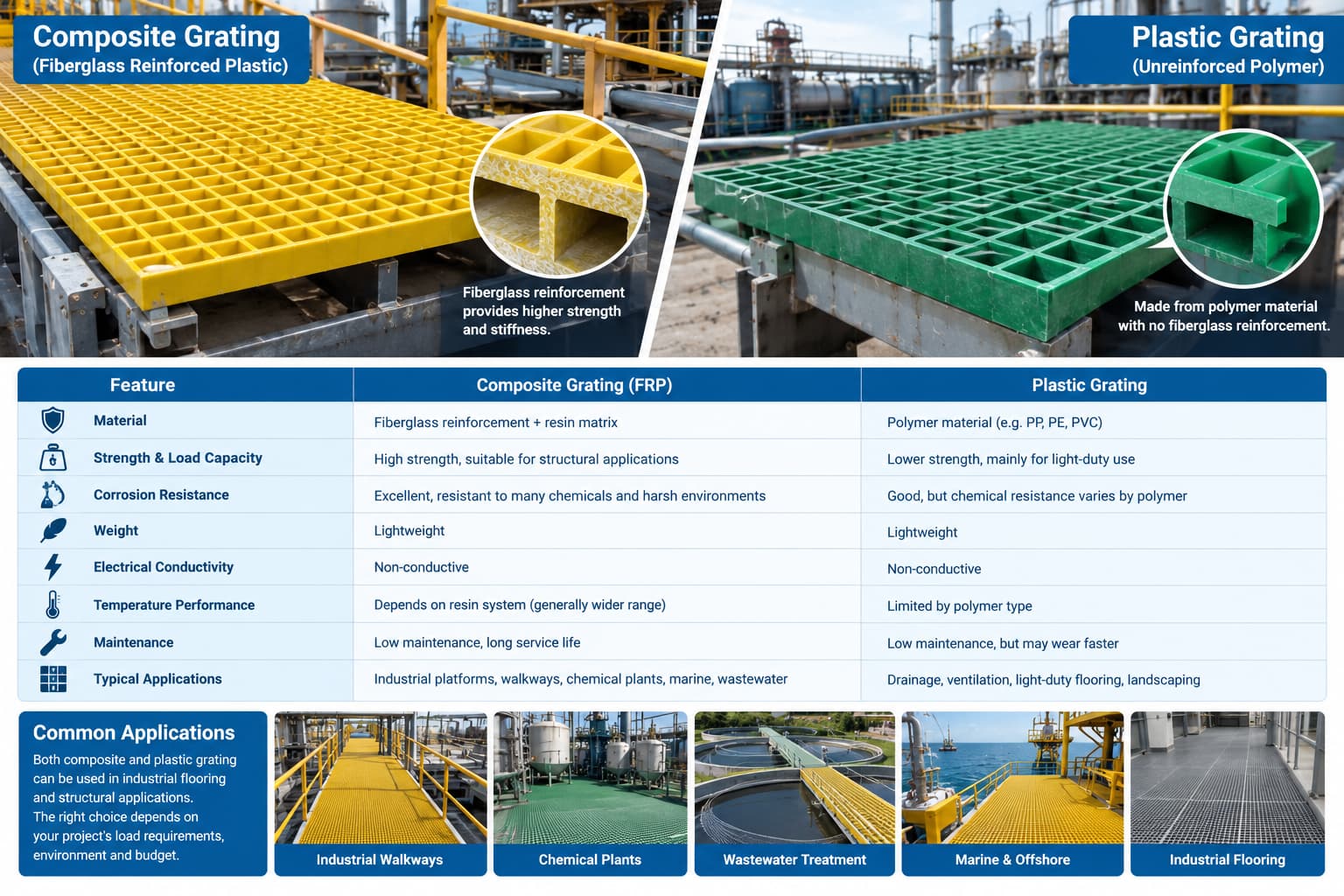
Composite grating and plastic grating may look similar at first glance, but their structural performance can be very different. The most important difference is usually not the word "plastic" itself, but whether the material contains a continuous reinforcement system such as fiberglass.
For industrial platforms, walkways, drainage covers and access structures, engineers should evaluate more than corrosion resistance. Load capacity, span, stiffness, temperature, impact resistance, slip resistance and long-term dimensional stability can all affect the correct material selection.
FRP grating is a type of reinforced composite grating made from fiberglass reinforcement and a thermosetting resin matrix. Preet's FRP grating products are available in molded and pultruded configurations for different load and application requirements.
What Is Composite Grating?
Composite grating is a broad category of grating manufactured from two or more materials to achieve a combination of structural and environmental properties.
In industrial applications, FRP composite grating commonly combines:
- Fiberglass reinforcement for structural strength
- Resin as the matrix material
- Surface treatments for slip resistance and durability
- Different resin systems for different environments
The fiberglass reinforcement carries a significant portion of the structural load, while the resin binds the reinforcement together and provides resistance to moisture and many chemicals.
This is why fiberglass-reinforced grating should not be treated as equivalent to an unreinforced plastic panel simply because both contain polymer materials.
What Is Plastic Grating?
Plastic grating generally refers to grating manufactured primarily from polymer materials without the same continuous fiberglass reinforcement used in structural FRP grating.
Depending on the product, plastic grating may be produced from materials such as polypropylene, polyethylene, PVC or other thermoplastic polymers.
Plastic grating can be useful for lightweight drainage, ventilation, pedestrian areas and applications where structural loads are limited. However, the performance of a specific plastic grating depends strongly on its polymer type, manufacturing method, geometry, temperature range and reinforcement, if any.
Therefore, "plastic grating" is a broad product category rather than a single standardized material.
Composite Grating vs Plastic Grating: Key Differences
| Property | FRP Composite Grating | Typical Plastic Grating |
|---|---|---|
| Reinforcement | Fiberglass reinforcement in resin matrix | Primarily polymer material; reinforcement varies by product |
| Structural Strength | High for properly designed structural profiles | Generally better suited to lighter-duty applications |
| Stiffness | Higher due to fiberglass reinforcement | Depends strongly on polymer and geometry |
| Corrosion Resistance | Excellent in many chemical and wet environments | Generally excellent against rust; chemical compatibility varies |
| Electrical Conductivity | Normally non-conductive | Normally non-conductive |
| Weight | Lightweight compared with steel | Usually lightweight |
| Temperature Performance | Depends on resin system and design | Highly dependent on polymer type |
| Long-Span Structural Use | Suitable for engineered structural applications | Often more limited |
1. Fiberglass Reinforcement Makes a Structural Difference
The primary engineering difference between FRP composite grating and ordinary plastic grating is reinforcement.
In FRP grating, fiberglass reinforcement provides a structural framework inside the polymer matrix. Continuous fiberglass can provide high longitudinal strength in pultruded products, while molded FRP grating uses a multidirectional reinforcement arrangement.
This reinforcement allows FRP grating to function as a structural flooring material rather than simply as a lightweight plastic screen.
For industrial applications where people, equipment or maintenance loads must cross a panel, the structural reinforcement becomes especially important.
2. Load Capacity and Span
Load capacity should be one of the first factors considered when selecting industrial grating.
A plastic drainage grid may perform well under its intended load but may not be appropriate for a long-span maintenance platform. FRP grating can be engineered with specific bearing-bar dimensions, panel thicknesses and support spacing to meet structural requirements.
Engineers should evaluate:
- Uniformly distributed load
- Concentrated load
- Support span
- Bearing-bar dimensions
- Panel thickness
- Allowable deflection
- Impact conditions
- Safety factors
For detailed engineering considerations, see FRP Grating Load Capacity: How Engineers Calculate Safe Loading Requirements.
3. Stiffness and Deflection
Strength alone does not determine whether a grating panel is suitable for an industrial platform.
A panel may have sufficient ultimate strength but still deflect too much under normal service loading. Excessive deflection can create an uncomfortable walking surface, affect equipment alignment or produce undesirable movement.
Fiberglass reinforcement generally gives FRP structural grating a higher stiffness than many unreinforced polymer products of similar geometry.
For engineered applications, span and deflection should therefore be considered together with the manufacturer's load tables and section properties.
See also FRP Grating Deflection: What Engineers Should Check Beyond Load Capacity.
4. Corrosion Resistance: Both Can Be Good, but the Chemistry Matters
Both FRP and many plastic materials can provide excellent resistance to rust because neither is based on conventional carbon steel.
However, corrosion resistance should not be interpreted as universal chemical resistance.
The correct material depends on the actual environment, including:
- Chemical type
- Chemical concentration
- Operating temperature
- Exposure duration
- Moisture level
- UV exposure
- Cleaning chemicals
For FRP grating, resin selection is particularly important. Isophthalic polyester and vinyl ester systems can provide different levels of chemical resistance and should be selected according to project conditions.
Read How to Choose the Right FRP Grating Resin for more information about resin selection.
5. Temperature and Dimensional Stability
Thermoplastic plastic products can soften or lose dimensional stability as temperature approaches the material's operating limit. The exact behavior depends on the polymer formulation.
FRP is also temperature-sensitive, particularly because the resin matrix influences the material's service-temperature performance. Therefore, FRP should not be described as completely temperature-proof.
For both materials, engineers should confirm the manufacturer's recommended operating temperature range before specifying the product near hot equipment, steam lines, furnaces or other high-temperature sources.
6. Slip Resistance and Worker Safety
For industrial flooring, material selection is only part of the safety equation. The surface finish is equally important.
FRP grating is commonly available with concave, molded or grit surfaces designed to improve traction in wet or oily environments.
This is particularly useful in:
- Wastewater treatment plants
- Chemical processing facilities
- Marine platforms
- Oil and gas facilities
- Cooling towers
- Industrial maintenance platforms
Plastic grating can also be manufactured with textured surfaces, but the appropriate slip performance must be verified for the intended application.
7. Weight and Installation
Both FRP and plastic grating are generally lighter than steel grating, which can simplify transportation and handling.
However, FRP structural grating offers an important combination of low weight and structural performance. This makes it particularly useful when the installation requires a relatively large structural panel without the weight of a conventional metal system.
| Installation Consideration | FRP Composite Grating | Plastic Grating |
|---|---|---|
| Manual Handling | Generally easy for industrial panels | Generally easy |
| Cutting | Requires suitable carbide or diamond tools | Often easy depending on polymer |
| Structural Supports | Can be designed for defined support spacing | Usually requires closer or application-specific support |
| Field Modification | Cutouts and drilling possible with proper methods | Generally straightforward depending on material |
8. Where FRP Composite Grating Is Usually the Better Choice
FRP composite grating is particularly suitable when the project requires a combination of structural performance and environmental resistance.
Typical applications include:
- Industrial walkways
- Elevated maintenance platforms
- Wastewater treatment structures
- Chemical processing plants
- Offshore and marine facilities
- Power plants and substations
- Cooling tower platforms
- Equipment access areas
- Trench covers and drainage structures
Preet FRP grating is available in both molded and pultruded forms. Molded grating provides multidirectional reinforcement, while pultruded grating is commonly selected when higher directional strength and longer spans are required.
Explore Preet FRP Grating Products for available grating configurations.
9. When Plastic Grating May Be More Appropriate
Plastic grating can still be the right choice when structural requirements are modest and other factors are more important.
For example, a lightweight polymer grid may be suitable for:
- Drainage areas
- Ventilation openings
- Light-duty pedestrian applications
- Equipment screens
- Decorative or architectural applications
- Temporary or easily replaceable installations
However, engineers should avoid selecting a plastic grating solely because it is inexpensive or lightweight. The product's actual load rating, span capability, temperature range and dimensional stability should be checked first.
10. Molded vs Pultruded FRP Composite Grating
When FRP composite grating is selected, the next decision is often whether a molded or pultruded construction is appropriate.
| Feature | Molded FRP Grating | Pultruded FRP Grating |
|---|---|---|
| Reinforcement | Multidirectional | Primarily longitudinal |
| Load Distribution | Good in multiple directions | Strong in the primary load direction |
| Typical Application | General industrial platforms and walkways | Longer spans and heavier structural applications |
| Design Priority | Balanced multidirectional performance | Higher directional structural performance |
For a detailed comparison, see Pultruded vs. Molded FRP Grating.
11. How to Select the Right Composite Grating
A practical selection process should start with the actual operating conditions rather than the material name.
- Define the load: Determine pedestrian, equipment, vehicle or maintenance loads.
- Confirm support spacing: Establish the clear span between structural supports.
- Check deflection: Confirm that the selected panel meets the required serviceability limits.
- Identify the environment: Consider chemicals, moisture, saltwater, UV exposure and temperature.
- Select the resin: Choose an FRP resin system compatible with the environment.
- Select the surface: Use an appropriate anti-slip finish for wet or contaminated areas.
- Evaluate connections: Confirm clips, fasteners and support frames are compatible with the grating.
- Verify manufacturer data: Use actual load tables and technical specifications rather than generic material assumptions.
12. Composite Grating vs Plastic Grating: Which Should You Choose?
There is no universal answer because the two materials are designed for different performance requirements.
Choose FRP composite grating when structural performance, long span, corrosion resistance, low maintenance and industrial durability are important.
Consider plastic grating when the application is lighter duty and low weight, drainage, ventilation or simple polymer construction is the primary requirement.
For industrial platforms, elevated walkways and maintenance structures, the structural reinforcement in FRP can provide a significant advantage over unreinforced plastic products.
The final selection should always be based on the manufacturer's load data, environmental compatibility and the engineering requirements of the project.
Conclusion
Composite grating and plastic grating may both provide lightweight and corrosion-resistant solutions, but their structural capabilities can be substantially different.
Fiberglass-reinforced composite grating combines a polymer matrix with fiberglass reinforcement, giving it the strength and stiffness required for many industrial flooring and platform applications. Plastic grating can be an economical solution for lighter-duty uses where structural loads and span requirements are limited.
For projects involving industrial walkways, chemical exposure, wastewater, marine environments or elevated maintenance platforms, FRP composite grating should be evaluated as a structural material rather than simply as a plastic alternative.
Need Help Selecting Composite Grating?
Share your required panel dimensions, support span, loading conditions and operating environment with the Preet team. We can help identify a suitable FRP grating type, thickness, surface and resin system for your application.
WhatsApp: +86 138 5147 5666
Email: info@preet.cn


