

What Is FRP Grating Load Capacity?
FRP grating load capacity refers to the maximum load that a fiberglass reinforced plastic grating panel can safely support under specified installation conditions. For engineers designing industrial platforms, walkways, stair treads and maintenance areas, understanding load capacity is essential for selecting the correct grating specification.
However, FRP grating load capacity is not determined by one value alone. The actual performance depends on several factors including support span, bearing bar direction, grating depth, load type, installation method and environmental conditions.
A grating panel with a higher advertised load capacity does not automatically mean it is suitable for every application. The load rating must always be evaluated together with the actual project requirements.
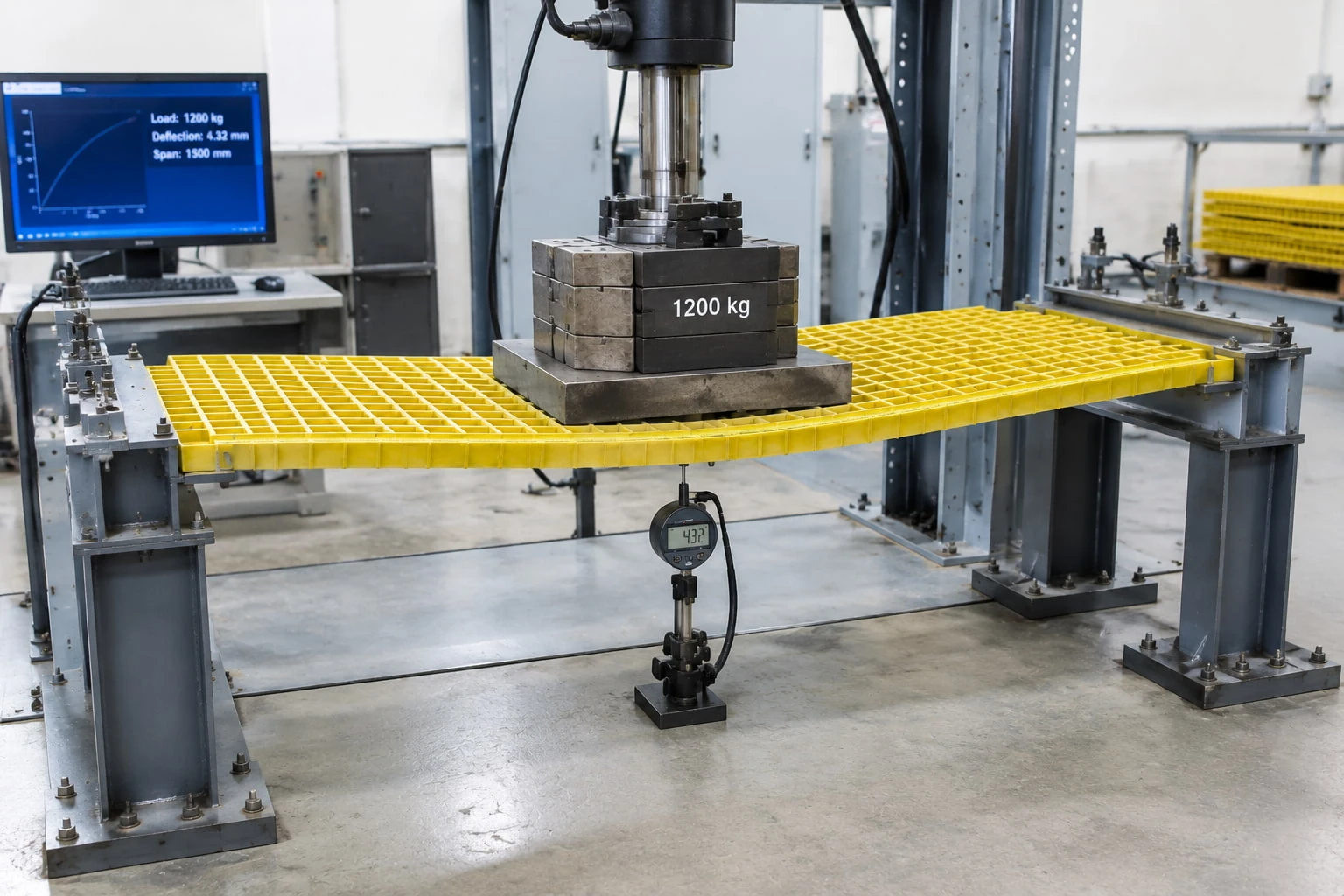
FRP grating load capacity testing evaluates how panels perform under controlled loading conditions.
Why Is FRP Grating Load Capacity Important?
FRP grating is commonly used in areas where workers, equipment and materials must safely move across elevated surfaces. Incorrect load selection can result in excessive deflection, uncomfortable movement, premature damage or unsafe operating conditions.
Load capacity evaluation is especially important for:
- Industrial walkways
- Process platforms
- Offshore maintenance areas
- Chemical plant access floors
- Cooling tower platforms
- Drainage channels
- Stair treads
- Equipment access platforms
What Factors Affect FRP Grating Load Capacity?
FRP grating strength is influenced by multiple design factors. Engineers should consider all of these factors before selecting a panel specification.
1. Support Span
The distance between supporting members is one of the most important factors affecting FRP grating load performance.
A shorter support span generally allows the grating to carry higher loads with less deflection, while a longer span increases bending stress and panel movement.
This is why FRP grating load tables are normally provided according to specific support spans rather than as a single universal capacity value.
Related article: FRP Grating Support Spacing: How to Determine Beam Spacing for Safe Installation
2. Bearing Bar Direction
FRP grating is directional in structural performance. The primary bearing bars must be installed correctly across the supporting structure.
If the panel is installed with the wrong orientation, the expected load capacity may not be achieved because the load is not transferred through the intended structural members.
3. Grating Depth and Thickness
FRP grating depth affects structural stiffness and load performance. Deeper grating profiles generally provide greater resistance to bending under load.
However, thickness alone does not determine performance. The fiberglass reinforcement structure, resin system and manufacturing method also influence the final strength characteristics.
4. Load Type
The type of load applied to FRP grating can significantly change the required specification.
| Load Type | Description | Example Application |
|---|---|---|
| Uniform Load | Load distributed across the surface | Personnel walkway loading |
| Concentrated Load | Load applied over a small area | Equipment feet or maintenance tools |
| Impact Load | Sudden or dynamic loading | Dropped materials or moving equipment |
How Do Engineers Calculate FRP Grating Load Capacity?
FRP grating load calculation involves evaluating the relationship between applied load, support span, structural properties and allowable deflection.
The main engineering considerations include:
- Applied load magnitude
- Distance between supports
- Grating profile dimensions
- Bearing bar properties
- Material characteristics
- Allowable stress limits
- Maximum acceptable deflection
Manufacturers typically provide load-span tables based on laboratory testing and engineering calculations. These tables allow designers to select suitable grating specifications according to project requirements.
FRP Grating Load Table: What Information Should Engineers Check?
| Parameter | Why It Matters |
|---|---|
| Grating Type | Molded or pultruded construction affects structural behavior |
| Panel Depth | Influences stiffness and bending resistance |
| Support Span | Determines actual structural condition |
| Load Type | Determines how forces are transferred |
| Deflection Limit | Ensures acceptable service performance |
FRP Grating Load Capacity for Walkways and Platforms
For pedestrian applications, engineers usually consider both safety and user comfort. A walkway should not only support the required load but should also provide acceptable stiffness during use.
Important considerations include:
- Maximum expected personnel load
- Maintenance equipment loads
- Concentrated loads from tools or carts
- Required safety factors
- Slip resistance requirements
- Environmental exposure
Preet Grating supplies FRP walkway grating for industrial access platforms and corrosion-resistant flooring applications.
Molded FRP Grating vs Pultruded FRP Grating Load Capacity
The manufacturing process affects how FRP grating carries loads.
| Type | Load Characteristic | Typical Application |
|---|---|---|
| Molded FRP Grating | Multi-directional load distribution | Platforms, walkways and corrosion areas |
| Pultruded FRP Grating | Higher directional strength along bearing bars | Long spans and heavy-duty applications |
Read more: Pultruded vs Molded FRP Grating: Which One Is Right for Your Project?
Common Mistakes When Selecting FRP Grating Load Capacity
Mistake 1: Selecting Only Based on Maximum Load
A maximum load value without considering span and deflection does not provide enough information for safe selection.
Mistake 2: Ignoring Concentrated Loads
Industrial platforms often experience localized loads from equipment, tools and maintenance activities.
Mistake 3: Installing Panels in the Wrong Direction
The bearing bars must be aligned correctly with the support structure to achieve the expected performance.
Mistake 4: Using Incorrect Span Information
Load tables are only meaningful when the actual support spacing matches the design condition.
FRP Grating Load Selection Checklist
| Check Item | Verification |
|---|---|
| Application | Walkway, platform, stair, trench or equipment area |
| Load Type | Uniform, concentrated or impact loading |
| Span | Actual distance between supports |
| Grating Type | Molded or pultruded construction |
| Environment | Chemical exposure, moisture and temperature |
| Deflection | Acceptable movement under service load |
How Preet Grating Helps With FRP Grating Load Selection
Selecting the correct FRP grating load capacity requires evaluating the complete application rather than choosing a panel based only on thickness or advertised strength.
Preet Grating provides molded FRP grating, pultruded FRP grating and customized solutions for industrial platforms, walkways, drainage systems and corrosive environments.
By reviewing span requirements, loading conditions, installation details and environmental factors, engineers can select an FRP grating system that provides reliable long-term performance.
Need Help Selecting FRP Grating Load Capacity?
Send us your application details, required span, loading conditions and project requirements. Our team can help recommend a suitable FRP grating specification.
WhatsApp: +86 138 5147 5666
Email: info@preet.cn
Conclusion: FRP grating load capacity depends on more than a single load value. Support span, grating construction, bearing bar direction, load type and deflection requirements must all be considered during engineering selection. By evaluating these factors together, designers can choose an FRP grating system that provides safe, durable and reliable performance for industrial applications.


