

What Is FRP Grating Support Spacing?
FRP grating is widely used for industrial platforms, walkways, maintenance areas, equipment access structures and other environments where corrosion resistance, slip resistance and low maintenance are important. However, selecting the right grating panel is only part of the design process. The distance between supporting members is equally important because support spacing determines the effective span of the grating panel and directly influences its structural performance and deflection.
For engineers, contractors and project buyers, FRP grating support spacing should be selected according to the specified grating construction, design loads, allowable deflection and actual support conditions. A panel should not be installed simply because its physical length matches the distance between structural members.
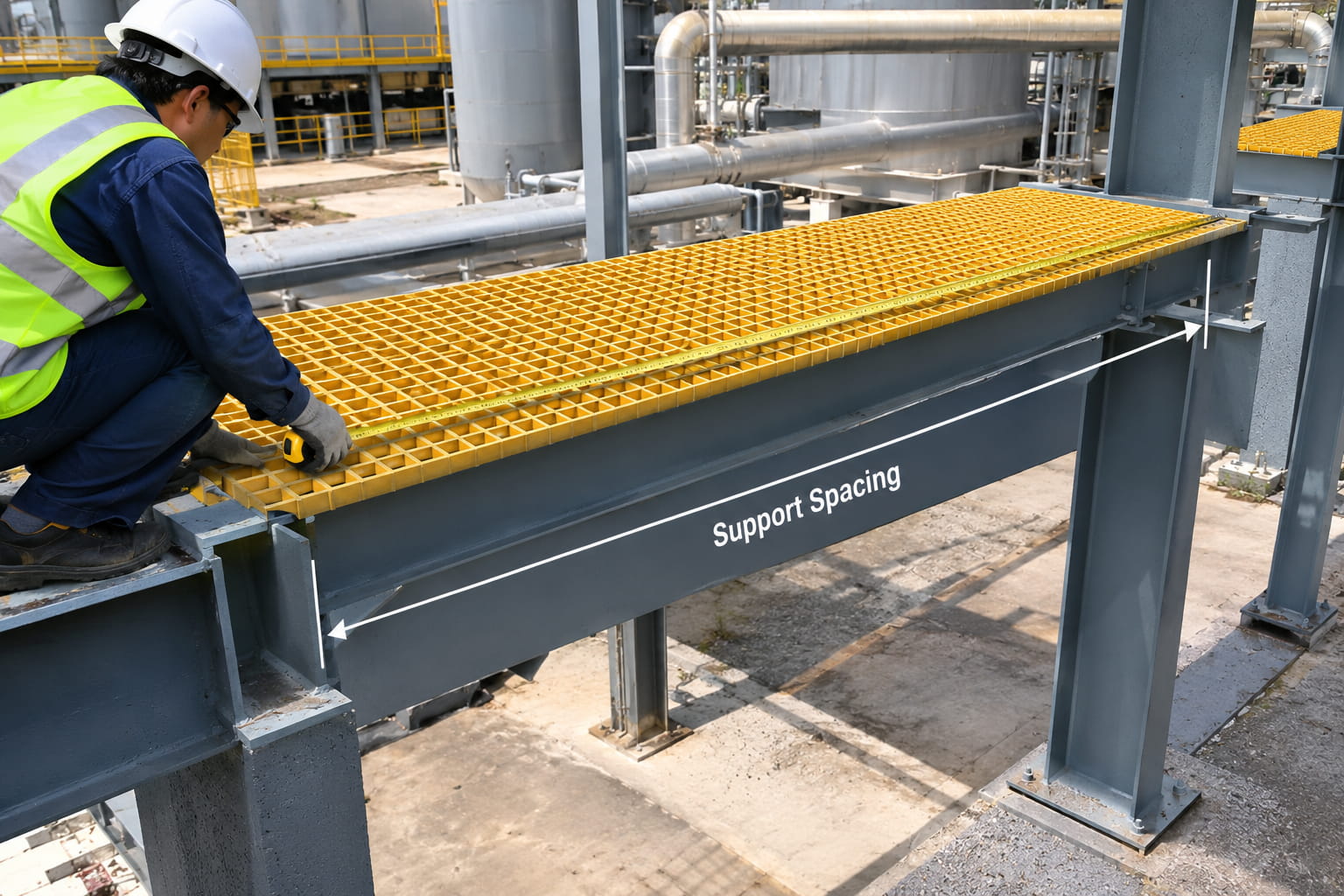
FRP grating support spacing should be evaluated according to the actual span, loading conditions and supporting structure.
Why Does Support Spacing Matter for FRP Grating?
FRP grating support spacing affects several aspects of structural and service performance. The same grating panel can behave differently when installed over different support distances.
- Load transfer: The grating must transfer applied loads safely to the supporting structure.
- Deflection: A longer unsupported span generally results in greater movement under load.
- Serviceability: Excessive flexibility can affect the walking experience and perceived stability of a platform.
- Panel selection: The required span may determine whether a particular grating depth and construction are appropriate.
- Structural layout: Additional intermediate supports may sometimes provide a more practical solution than selecting a substantially heavier grating system.
Therefore, a reliable FRP grating specification should consider load, span and deflection together rather than using load capacity as the only selection criterion.
How to Determine the Required FRP Grating Support Spacing
There is no single support spacing that applies to every FRP grating installation. The appropriate distance depends on the specific panel specification, loading conditions and structural arrangement of the project.
1. Define the Design Load
The first step is to understand what the grating will actually carry.
A pedestrian maintenance walkway may primarily experience personnel loading, while an industrial platform can also be exposed to tools, carts, equipment or other concentrated loads. Outdoor platforms and process areas may have additional operational considerations.
Both distributed and concentrated loads should be considered where they are relevant to the project. A concentrated load can produce a different structural response from an equivalent uniformly distributed load.
If you need to evaluate the relationship between load and span, see our guide on FRP grating load tables and span calculations.
2. Identify the Grating Construction
FRP grating is manufactured in different constructions, including molded and pultruded designs. Bearing bar geometry, panel depth, fiberglass reinforcement, resin system and manufacturing process can all affect structural performance.
As a result, two FRP grating panels with similar overall dimensions should not automatically be assumed to have identical span characteristics.
For applications where longer spans or higher structural efficiency are required, engineers should compare the technical data for the specific grating construction rather than selecting a panel based only on its thickness.
Preet Grating supplies molded FRP grating and pultruded FRP grating for different industrial applications.
3. Check the Manufacturer's Span and Load Data
Once the design load and grating construction are known, the manufacturer's technical information should be used to verify the suitable span.
Instead of asking only, "How much load can the grating support?", engineers should also determine:
- What is the required unsupported span?
- What design load applies to the span?
- What deflection is expected under the design load?
- Is the loading distributed, concentrated or a combination of both?
- Are additional intermediate supports required?
This approach helps connect the grating specification with the actual structural layout of the project.
FRP Grating Support Spacing and Panel Thickness
Panel thickness is an important specification, but thickness alone does not determine the allowable span.
A thicker panel will generally provide greater structural stiffness than a thinner panel of otherwise similar construction. However, bearing bar geometry, reinforcement configuration, resin system and manufacturing method can also affect the performance of the finished product.
For this reason, project specifications should identify the complete grating construction and required structural performance instead of specifying thickness as the only engineering parameter.
Where the structural requirement calls for a particular span, the supplier should confirm the appropriate grating specification using the manufacturer's engineering data.
Pay Attention to the Load-Bearing Direction
FRP grating is directional. The primary load-bearing bars are designed to span between the supporting members.
During installation, the bearing-bar direction should therefore be positioned correctly relative to the supports. A panel installed in the wrong orientation may not provide the intended structural performance.
Before cutting, placing or fixing panels, installers should confirm the load-bearing direction from the product drawings or technical documentation.
Correct orientation is particularly important when grating panels are being fitted around columns, pipes, drains or equipment openings because cutting and panel layout can change the supporting arrangement.
What Happens When FRP Grating Supports Are Too Far Apart?
If the support spacing is greater than the appropriate span for the selected grating, several problems can occur.
- Increased deflection under normal operating loads.
- A noticeably flexible feeling when personnel walk across the panel.
- Higher stress within the load-bearing bars.
- Greater sensitivity to concentrated loads.
- Potential damage to the grating or connections under severe service conditions.
It is important to distinguish between strength and serviceability. A grating panel may have sufficient ultimate strength while still deflecting more than is desirable for a particular application.
For engineering projects, allowable deflection should therefore be reviewed separately from ultimate load capacity.
Should You Add More Supports or Use Thicker Grating?
When the required span is too large, there are usually several possible approaches.
Option 1: Add Intermediate Supports
Adding an intermediate beam or support reduces the effective span of the grating. This can be a practical solution when the structural frame allows additional members to be installed.
Reducing the span can also improve serviceability by limiting deflection.
Option 2: Select a Different Grating Specification
Where additional supports are difficult to install, a grating with a different structural configuration may be considered.
Depending on the application, engineers may evaluate different panel depths, bearing-bar configurations or pultruded grating designs.
The final selection should be based on the manufacturer's technical data rather than assuming that a thicker panel automatically provides the required performance.
Support Spacing for Industrial Walkways and Platforms
Industrial walkways often have relatively predictable pedestrian loading, but the surrounding environment still matters.
For example, a maintenance walkway above process equipment may experience occasional personnel traffic, while a platform around pumps, tanks or production machinery may also need to accommodate tools and maintenance equipment.
The design should therefore reflect the actual operating conditions rather than relying on a generic support-spacing rule.
For walkway applications, Preet Grating provides FRP walkway grating for industrial access and maintenance areas.
How Concentrated Loads Affect Support Requirements
One common mistake is to evaluate a grating system only against a uniformly distributed load.
Industrial grating can also experience localized loads from personnel standing in one area, equipment feet, maintenance tools, carts or temporary materials.
Where concentrated loading is expected, the panel and support arrangement should be checked specifically for that condition. Additional structural support may be required depending on the size and location of the load.
Engineers should avoid assuming that a concentrated load will produce the same structural response as an equivalent load distributed across a larger area.
Support Spacing and FRP Grating Installation
Support spacing should be confirmed before the grating panels are cut and installed.
The installation process should account for:
- Actual dimensions between structural supports.
- Load-bearing bar orientation.
- Panel joints and bearing locations.
- Openings for pipes, drains and equipment.
- Required fixing and connection points.
- Potential movement caused by operating or environmental conditions.
For a detailed installation sequence, see our article How to Install FRP Grating.
Appropriate fiberglass grating clips and fasteners should also be selected according to the panel configuration and supporting structure.
FRP Grating Support Spacing Checklist
| Design Factor | What Should Be Checked? |
|---|---|
| Design load | Distributed and concentrated loads expected during service |
| Effective span | Actual distance between direct supports |
| Grating construction | Molded or pultruded construction and bearing-bar configuration |
| Panel depth | Grating thickness and structural stiffness |
| Deflection | Allowable serviceability limit for the application |
| Orientation | Primary load-bearing bars positioned correctly across supports |
| Openings | Cutouts around pipes, drains, columns and equipment |
| Environment | Moisture, corrosion, UV exposure and temperature conditions |
| Connections | Suitable clips and fixing arrangement |
Common FRP Grating Support Mistakes
Using Panel Length as the Support Spacing
A grating panel's overall length does not automatically define the allowable structural span. The effective span must be evaluated based on the actual support arrangement and the product's engineering data.
Considering Load Capacity but Ignoring Deflection
Ultimate load capacity and serviceability are not the same thing. A design should consider both structural strength and acceptable movement under normal operating conditions.
Ignoring Bearing-Bar Direction
Because FRP grating has a primary load-bearing direction, incorrect orientation can change how loads are transferred to the supports.
Assuming All FRP Grating Products Perform the Same
FRP grating products differ in construction, reinforcement, resin system, bearing-bar geometry and manufacturing process. Technical specifications should therefore be checked for the exact product being supplied.
Adding Cutouts Without Reviewing the Support Layout
Large openings can interrupt load-bearing bars and change the way loads are transferred around the opening. When significant cutouts are required, the surrounding support arrangement should be reviewed before fabrication.
How Preet Grating Supports FRP Grating Selection
For industrial projects, FRP grating should be specified as part of the complete structural and installation system rather than as an isolated floor panel.
Preet Grating supplies FRP grating and pultruded FRP profiles for industrial platforms, walkways, maintenance areas and corrosive environments. Project requirements such as grating type, panel dimensions, loading conditions, support arrangement and surface requirements can be reviewed before production.
Where the supporting structure also requires corrosion-resistant composite components, engineers can evaluate FRP pultruded structural profiles as part of the overall system.
For project-specific applications, the recommended approach is to provide the supplier with the required span, design load, panel dimensions, support layout and operating environment so that the appropriate product specification can be evaluated.
Conclusion
FRP grating support spacing should be determined from the relationship between design load, effective span, grating construction and allowable deflection. There is no universal spacing value that can safely be applied to every FRP grating installation.
The practical engineering process is to define the design loads, identify the required grating construction, establish the actual unsupported span and verify the manufacturer's load and deflection data. If the required span is too large, additional structural supports or a different grating specification may be considered.
Early coordination between the structural engineer, grating supplier and installer can help prevent incorrect panel orientation, excessive deflection, unnecessary cutting and avoidable material costs.
Key Takeaway: Do not determine FRP grating support spacing from panel length alone. Always verify the actual span, design load, bearing-bar direction, grating construction and allowable deflection for the specified application.
Discuss Your FRP Grating Project
If you need help selecting FRP grating for a specific support span, load condition or industrial environment, contact the Preet Grating team with your project dimensions and requirements.
WhatsApp: +86 138 5147 5666
Email: info@preet.cn
Our team can review the required span, loading conditions, panel dimensions, surface requirements and supporting arrangement to help identify a suitable FRP grating specification.


