

What Is FRP Grating with a Cover Plate?
FRP grating with a cover plate, also referred to as a GRP cover plate grating, is a composite panel made by bonding a molded fiberglass grating with a flat FRP plate. Depending on the project, the cover can be applied to one side or both sides of the grating to create a more closed structural panel.
In some project inquiries, terms such as GRP sealing plate, FRP cover plate, or fiberglass cover plate may be used to describe this type of covered grating. For engineering and purchasing purposes, it is important to confirm whether the requirement is for a complete covered grating panel or for a separate flat FRP plate.
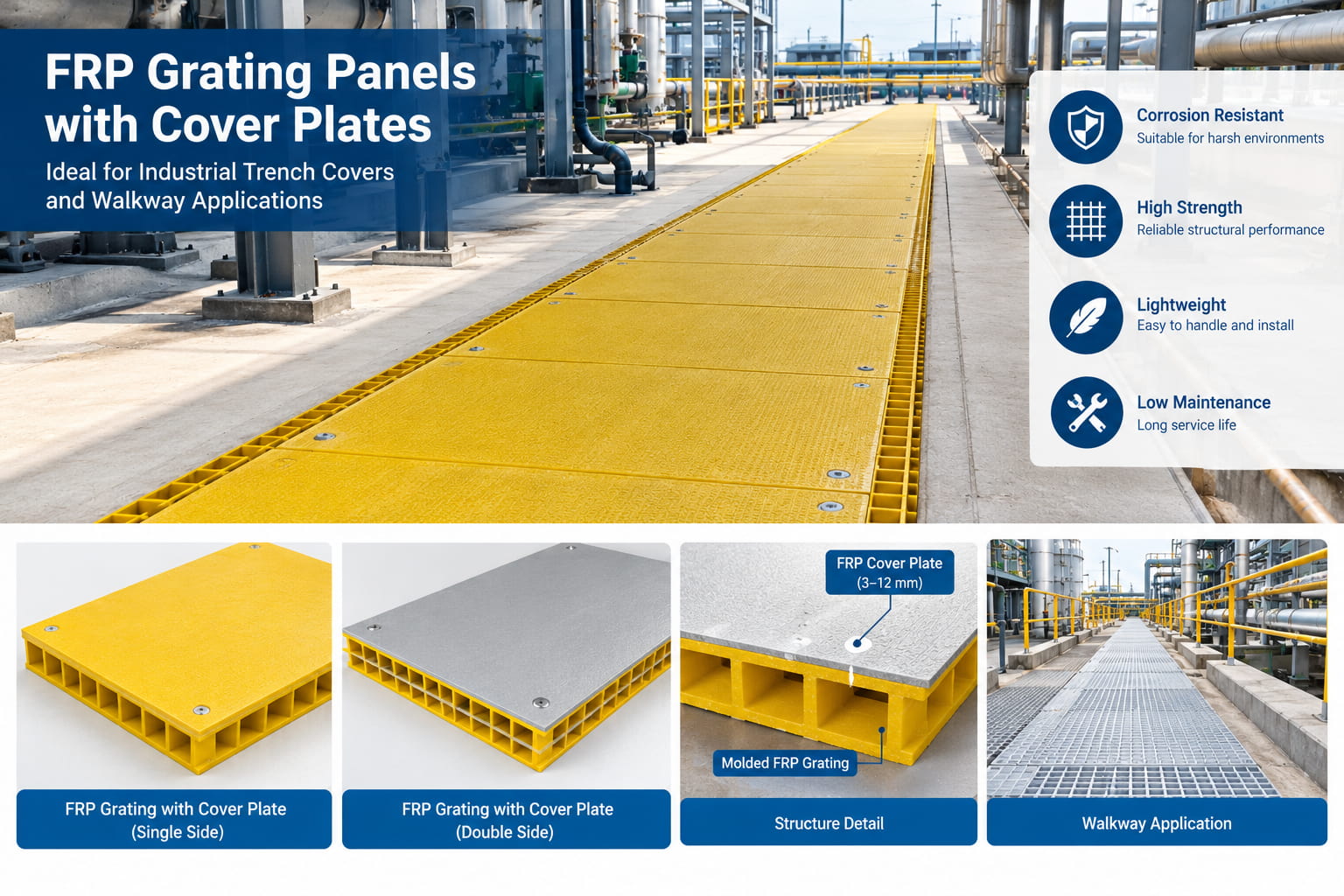
FRP grating with cover plates combines an open grid structure with a bonded FRP cover surface for applications requiring a more closed panel.
How Is an FRP Cover Plate Grating Constructed?
According to the Preet product catalog, the covered grating is produced by bonding a molded GFRP grid with a hand-laid FRP flat plate. The resulting panel can have a single-sided or double-sided closed structure.
This construction is different from a conventional open-mesh FRP grating. The underlying grating provides the structural grid, while the cover plate creates a substantially more closed upper or lower surface.
| Component | Function |
|---|---|
| Molded FRP grating | Provides the grid structure and load-bearing framework. |
| FRP flat cover plate | Creates a more closed surface and can help isolate material, debris or odors from the space below. |
| Bonded interface | Joins the cover plate and grating into one composite panel. |
FRP Cover Plate Thickness: 3–12 mm
One important selection parameter is the thickness of the FRP cover plate itself. The Preet catalog specifies a cover plate thickness range of 3–12 mm, with the final design selected according to the required load conditions.
This should not be confused with the total thickness of the covered grating. For example, a configuration containing a 25 mm grating plus a 3 mm cover plate has a different total thickness from a 30 mm grating combined with a 3 mm cover plate.
| Parameter | Catalog information | Why it matters |
|---|---|---|
| Cover plate thickness | 3–12 mm | Selected according to project load and panel requirements. |
| Grating thickness | Depends on the selected grating configuration | Affects the structural configuration of the complete panel. |
| Total thickness | Depends on the grating and cover configuration | Important for elevation, support details and installation clearance. |
Standard FRP Cover Plate Grating Specifications
Preet's product catalog lists several standard covered-grating configurations. The following data should be used as the reference when discussing the company's standard product range.
| Total Thickness (mm) | Structure (mm) | Mesh Size (mm) | Catalog Weight | Standard Size (mm) |
|---|---|---|---|---|
| 28 | 25 + 3 | 38 × 38 | 17.6 | 1220 × 3660 / 1220 × 4040 |
| 31 | 3 + 25 + 3 | 38 × 38 | 23 | 1220 × 3660 / 1220 × 4020 |
| 33 | 30 + 3 | 38 × 38 | 20.4 | - |
| 36 | 3 + 30 + 3 | 38 × 38 | 25.8 | - |
| 41 | 38 + 3 | 38 × 38 | 24.5 | - |
| 44 | 3 + 38 + 3 | 38 × 38 | 29.9 | - |
| 43 | 40 + 3 | 40 × 40 | 24.4 | - |
| 46 | 3 + 40 + 3 | 40 × 40 | 29.8 | - |
| 55 | 50 + 5 | 50 × 50 | 31 | 1220 × 3660 / 1220 × 4020 |
Three FRP Cover Plate Surface Options
The Preet catalog identifies three cover plate surface types: smooth cover plate, checker cover plate, and sanded/grit cover plate.
- Smooth cover plate: suitable when a relatively flat closed surface is required.
- Checker cover plate: provides a textured surface configuration.
- Sanded/grit cover plate: adds a more pronounced anti-slip surface and can be considered where slip resistance is an important project requirement.
Surface selection should be based on the actual operating environment, footwear, contamination, drainage requirements and cleaning conditions rather than simply choosing the most aggressive surface.
When Should You Choose a Covered FRP Grating?
Covered FRP grating is particularly useful when an open mesh is not suitable for the operating requirement. The cover plate creates a more closed surface while retaining the underlying FRP grating structure.
| Project requirement | Why covered grating may be considered |
|---|---|
| Trench and drainage areas | Provides a more closed cover over the opening while retaining the FRP structural grid underneath. |
| Industrial walkways | Useful where a more continuous walking surface is preferred. |
| Chemical and wastewater facilities | FRP construction is suitable for environments where corrosion resistance and low maintenance are important considerations. |
| Areas requiring odor isolation | The catalog specifically notes that covered grating can help isolate odor emissions. |
FRP Cover Plate vs. Open FRP Grating
| Feature | Open FRP Grating | FRP Grating with Cover Plate |
|---|---|---|
| Surface | Open mesh | More closed surface |
| Drainage | Open mesh allows direct drainage through the grating | Drainage behavior depends on the cover configuration and project design |
| Debris passage | Small objects can pass through mesh openings | Cover reduces direct passage through the panel |
| Typical selection logic | Best when drainage, ventilation and open-area access are priorities | Best when a more closed walking or covering surface is required |
How to Select the Right GRP Sealing Plate or Cover Grating
For an engineering project, do not select a covered grating only by the term "GRP sealing plate." Confirm the complete panel construction and operating conditions.
- Define the application: determine whether the panel will be used as a trench cover, walkway, platform, access panel or another structural component.
- Confirm the design load: identify pedestrian, maintenance, equipment or other expected loads and provide the support span.
- Select the grating configuration: consider mesh size and grating thickness together rather than evaluating the cover plate alone.
- Select cover thickness: Preet's catalog provides cover plate thicknesses from 3–12 mm, with the final design depending on project requirements.
- Choose the surface: compare smooth, checker and sanded/grit surfaces according to slip resistance and cleaning requirements.
- Confirm panel dimensions: use the catalog standard sizes where suitable, or provide project drawings when custom fabrication is required.
- Check support and fixing details: the complete panel design should be checked against the actual support arrangement and installation method.
For load-bearing applications, the cover plate thickness should not be treated as an independent substitute for structural design. The grating thickness, mesh configuration, span, support conditions and applied load all need to be considered together.
Why Covered FRP Grating Is Used in Corrosive Environments
FRP is often selected for industrial areas where corrosion resistance, electrical insulation and low-maintenance operation are important. The company catalog describes FRP grating as suitable for chemical plants, wastewater treatment facilities, power plants, offshore platforms and other industrial environments.
Covered grating extends this product concept to applications where a more closed surface is required. This makes it relevant for trench covers, operating platforms, walkways and other areas where the project designer needs more than a conventional open-grid panel.
FRP Cover Plate Grating Selection Checklist
| Item | Information to confirm |
|---|---|
| Application | Trench, walkway, platform, access area or other use |
| Load | Expected load and load distribution |
| Span | Actual support spacing |
| Grating | Mesh size and grating thickness |
| Cover | Cover plate thickness and one-sided or two-sided configuration |
| Surface | Smooth, checker or sanded/grit |
| Dimensions | Required panel length, width and cutouts |
Conclusion
FRP grating with a cover plate is not simply a standard fiberglass grating with a cosmetic top layer. It is a composite structural panel formed by combining a molded FRP grating with a hand-laid FRP cover plate. Preet's catalog specifies cover plate thicknesses from 3 to 12 mm and provides multiple configurations using 38 × 38, 40 × 40 and 50 × 50 mm mesh sizes.
The right specification should be selected from the complete project requirements: load, span, grating thickness, mesh, cover thickness, surface type and panel dimensions. For trench covers, industrial walkways and corrosive environments, this approach provides a more reliable basis for product selection than choosing a cover plate by thickness alone.
For related information, see FRP/GRP Cover Plate Gratings, Molded FRP Grating, and FRP Trench Cover.
Need help selecting a covered FRP grating? Send us your required panel dimensions, support span, expected load, mesh size and application environment for technical evaluation.
Contact us on WhatsApp: +86 138 5147 5666
Email: info@preet.cn


