

Introduction
Industrial ladders provide access to elevated platforms, equipment, tanks, service areas, and maintenance locations. In corrosive or electrically sensitive environments, conventional metal ladders may require additional protection or specialized material selection. Fiberglass reinforced plastic (FRP) offers an alternative for applications where corrosion resistance, low weight, and electrical insulation are important considerations.
FRP industrial ladder systems can be manufactured from pultruded fiberglass profiles and combined with suitable rungs, brackets, fasteners, cages, or platform components, depending on the design. However, not every FRP ladder is suitable for every height, load, or working environment. The complete assembly must meet the project's access, structural, and safety requirements.
This guide explains common FRP ladder configurations, their main components, typical applications, and the factors to review when specifying a fiberglass ladder system for industrial use.
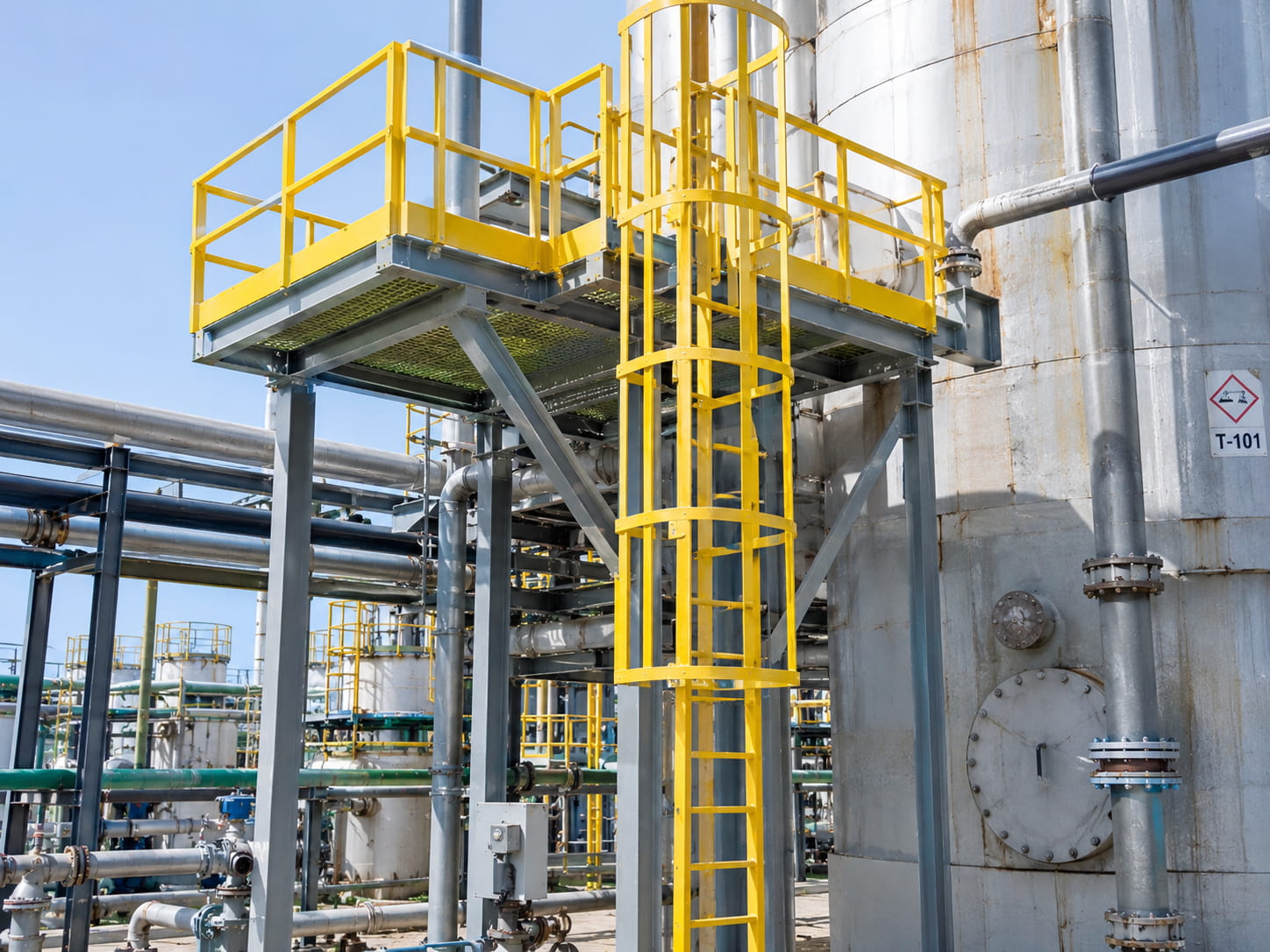
1. What Is an FRP Industrial Ladder?
An FRP industrial ladder is an access structure made partly or entirely from fiberglass reinforced polymer components. The material combines glass fiber reinforcement with a resin matrix to create profiles that can provide structural performance with relatively low weight and resistance to many corrosive environments.
FRP ladder components are often manufactured through pultrusion, a process in which continuous fiberglass reinforcement is combined with resin and pulled through a forming die. This process is suitable for producing profiles with a consistent cross-section, such as square tubes, rectangular tubes, channels, and other structural shapes.
The ladder's performance depends on more than the material alone. Profile geometry, rung design, connections, anchorage, installation conditions, and the overall structural arrangement all affect the suitability of the completed system.
2. Common Types of FRP Industrial Ladders
The appropriate ladder configuration depends on how frequently the access point is used, the height to be reached, the available space, the surrounding equipment, and the applicable safety requirements.
Fixed FRP Ladders
Fixed FRP ladders are permanently attached to a structure to provide access to equipment, elevated work areas, tanks, or service platforms. They may be suitable for industrial locations where corrosion resistance and low-maintenance construction are important.
Before specifying a fixed ladder, confirm the required access height, mounting arrangement, rung spacing, climbing clearance, anchorage, and any fall-protection provisions required by local regulations.
FRP Ladders with Access Platforms
Some industrial installations require a ladder connected to a landing or maintenance platform. The platform provides a transition area where workers can access equipment or move between elevations.
In these systems, the ladder, platform, guardrails, and supporting structure must be evaluated as a complete assembly. Platform grating, support profiles, connection hardware, and access openings should be coordinated during the design stage.
FRP Ladder and Handrail Assemblies
FRP ladder systems may be integrated with fiberglass handrails or guardrails where the layout requires additional edge protection or a defined access route. The railing configuration should be selected according to the platform layout, access opening, expected loads, and applicable safety requirements.
Handrails and guardrails serve different functions from ladder climbing components. Their dimensions, attachment details, and load requirements should therefore be verified separately rather than assumed to be covered by the ladder design.
Portable Fiberglass Ladders
Portable fiberglass ladders are a separate product category from fixed FRP industrial access systems. They are commonly used for temporary access and maintenance tasks where a non-conductive ladder material is desirable.
Portable ladders must be selected according to their intended duty rating, height, configuration, inspection requirements, and relevant safety standards. A structural FRP profile or custom-built fixed ladder should not be treated as a certified portable ladder unless it has been designed and approved for that purpose.
3. Main Components of an FRP Ladder System
Understanding the components helps engineers and purchasing teams evaluate the complete system rather than choosing a ladder based on appearance alone.
Side Rails or Stringers
Side rails form the main longitudinal members of a ladder. They support the rungs and transfer loads to the mounting points or supporting structure. Their cross-section, wall thickness, length, and connection details must be suitable for the intended application.
Rungs and Climbing Surfaces
Rungs provide footholds during climbing. Their shape, spacing, surface texture, attachment method, and usable width affect access and safety. Where wet, oily, or contaminated conditions are expected, the specified surface should be suitable for the actual operating environment.
Brackets and Fasteners
Brackets and fasteners connect the ladder to the surrounding structure. Material compatibility is particularly important in chemical plants, coastal facilities, and other corrosive locations. The selected hardware should meet the project's strength and corrosion-resistance requirements.
Mounting and Anchorage
Mounting details transfer the ladder loads into the supporting structure. The supporting wall, steel frame, concrete structure, or FRP framework must be capable of carrying the relevant loads. Anchors should be selected for the substrate and installation conditions, with the design checked by a qualified professional where required.
Cages, Guardrails, and Landing Platforms
Depending on the ladder height, configuration, and applicable regulations, additional components may be required for fall protection or safe access. These may include ladder cages, personal fall-arrest system provisions, guardrails, gates, or landing platforms.
The correct protection method must be determined from the governing safety rules and the actual ladder design. A cage should not automatically be assumed to satisfy every fall-protection requirement.
4. Advantages of FRP Ladders in Industrial Environments
FRP can offer several material-related advantages in demanding environments. The benefits realized by a particular ladder system depend on the resin, fiber reinforcement, profile design, hardware, and installation conditions.
Corrosion Resistance
FRP does not rust like conventional carbon steel. This can be beneficial in wastewater treatment plants, chemical processing facilities, coastal installations, and other environments where moisture or corrosive substances may accelerate metal deterioration.
However, chemical resistance varies with resin formulation, chemical concentration, temperature, and exposure duration. The manufacturer should confirm that the selected material is suitable for the intended environment.
Lightweight Construction
FRP profiles are generally lightweight compared with many metal alternatives of comparable dimensions. Lower component weight can simplify transportation, handling, and installation, although lifting and installation procedures must still follow the project's safety plan.
Electrical Insulation
FRP is generally electrically non-conductive, which can be useful in selected electrical and utility environments. This characteristic does not make an FRP ladder automatically safe for work near energized equipment. Required clearances, electrical work procedures, product qualifications, and applicable regulations must still be followed.
Reduced Corrosion-Related Maintenance
FRP does not require conventional rust-prevention painting in the same way as unprotected carbon steel. Nevertheless, routine inspection remains necessary to identify mechanical damage, loose fasteners, surface deterioration, or problems at mounting points.
Design Flexibility
Pultruded FRP profiles are available in different cross-sectional shapes and can be combined into custom structural arrangements. This may help when a ladder must be integrated with a platform, guardrail, equipment frame, or other access structure.
Any custom design still requires verification of structural capacity, connection strength, dimensional requirements, and compliance with relevant access and safety standards.
5. Where Are FRP Industrial Ladders Used?
FRP ladder systems are commonly considered where access equipment must withstand challenging environmental conditions or where non-metallic construction is desirable.
Chemical Processing Plants
Chemical plants may expose access structures to splashes, vapors, washdown water, and corrosive atmospheres. FRP ladders can be considered when the selected resin and associated hardware are compatible with the actual chemical exposure.
Water and Wastewater Treatment Facilities
Water and wastewater facilities often contain wet areas, tanks, channels, pumps, and elevated service points. FRP ladders may provide access to these locations where corrosion resistance and maintenance requirements are important selection factors.
Marine and Coastal Installations
Marine and coastal facilities can experience salt spray, high humidity, and persistent moisture. An FRP access system may be appropriate when the material, connections, and structural design are suitable for the site's environmental and loading conditions.
Power and Utility Facilities
Some utility and electrical facilities use FRP access components because of their non-conductive material properties. The complete installation must still satisfy the relevant electrical safety requirements, access rules, and structural criteria.
Industrial Platforms and Equipment Access
FRP ladders can be integrated with walkways, maintenance platforms, and equipment support structures. Where FRP grating is used for platform flooring, the ladder opening, edge protection, support layout, and connection arrangement should be coordinated to avoid access conflicts.
For related flooring options, see the FRP Grating product range.
6. How to Select the Right FRP Ladder
Selection should begin with the access task and site requirements. A ladder suitable for occasional inspection may not be suitable for frequent access or for a location where workers carry tools and equipment.
Step 1: Define the Access Purpose
Identify the destination, access frequency, number of users, expected maintenance activities, and whether workers will carry tools or materials. Determine whether a fixed ladder, portable ladder, or ladder with a landing platform is appropriate.
Step 2: Confirm Height and Available Space
Measure the required climbing height and review the space available around the ladder. Check headroom, climbing clearance, access openings, nearby pipes, equipment, and the space needed to enter and exit safely.
Step 3: Establish Structural Requirements
Determine the loads and design conditions required by the applicable standard. Review the side rails, rungs, supports, connections, and anchors as parts of one structural system. Do not select profile dimensions based on visual similarity to another ladder.
Step 4: Evaluate the Operating Environment
Consider moisture, chemicals, salt spray, ultraviolet exposure, temperature, and any project-specific fire-performance requirements. Ask the manufacturer to confirm the suitability of the proposed resin system and components.
Step 5: Check Safety and Regulatory Requirements
Confirm the applicable ladder, access, guardrail, and fall-protection requirements for the project location. Requirements may vary with ladder height, usage, industry, and jurisdiction.
Verify whether cages, rest platforms, gates, or a personal fall-arrest system are required. Do not assume that one protective arrangement is appropriate for every ladder configuration.
Step 6: Review Connections and Installation
Check how the ladder will attach to the supporting structure, what hardware is required, and whether installation access is available. The installation plan should address alignment, anchorage, fastener compatibility, and inspection of the completed assembly.
Step 7: Request Product Documentation
Ask the supplier for dimensional drawings, material information, relevant load data, installation instructions, and applicable test or compliance documents. Confirm that the documentation corresponds to the exact configuration being quoted.
7. FRP Ladder Installation and Safety Checks
Correct installation is essential to the performance of a fixed FRP ladder. Installation should follow the approved drawings, the manufacturer's instructions, and the applicable site safety procedures.
Inspect Components Before Assembly
Check side rails, rungs, brackets, and other supplied components for visible cracks, delamination, shipping damage, or dimensional discrepancies. Damaged components should be assessed before use rather than installed without review.
Verify Alignment and Anchorage
Confirm that the ladder is aligned with the approved layout and that mounting points are attached to the specified supporting structure. Check the anchors and fasteners against the approved connection details.
Check Climbing Clearance and Access Openings
Ensure that surrounding pipes, cables, walls, and equipment do not obstruct climbing or safe entry and exit. Where a ladder connects to a platform, review the opening and edge-protection arrangement as part of the overall access design.
Inspect Rungs and Protective Components
Verify that the rungs are secure and undamaged and that any specified cages, rails, gates, or fall-protection provisions are installed correctly. The required arrangement should be checked against the applicable regulations and design documentation.
Document the Final Inspection
Record any defects, deviations, or outstanding items and resolve them before the ladder is placed into service. Inspection frequency after handover should be based on the operating environment, usage, manufacturer recommendations, and applicable site procedures.
8. Common FRP Ladder Selection Mistakes
Choosing by Material Alone
Although FRP offers corrosion resistance and low weight, those properties do not establish that a ladder is structurally suitable. The complete configuration must meet the required loads and access standards.
Ignoring the Supporting Structure
A correctly manufactured ladder can still be unsafe if the supporting wall, frame, or anchorage is inadequate. Review the complete load path from the ladder into the building or equipment structure.
Overlooking Chemical Compatibility
Not all FRP resin systems have the same chemical resistance. Confirm the exposure conditions and obtain product-specific guidance before specifying a ladder for aggressive environments.
Assuming FRP Eliminates Electrical Risk
FRP's non-conductive properties do not replace safe working distances, electrical isolation procedures, suitable protective equipment, or other requirements for work near electrical hazards.
Using an Unverified Custom Design
Custom ladder assemblies may require specialized brackets, profile sections, and connection details. Verify the design and documentation before fabrication and installation rather than relying on an improvised arrangement.
9. Questions to Ask an FRP Ladder Supplier
Before purchasing a fiberglass ladder system, provide the supplier with enough information to evaluate the intended application and identify suitable components.
- Is the product designed for fixed industrial access or portable use?
- What ladder configurations, profile dimensions, and rung options are available?
- Can the supplier provide structural data and drawings for the proposed assembly?
- Which resin system and surface options are suitable for the site environment?
- What fasteners, brackets, and mounting details are recommended?
- What installation, inspection, and maintenance documentation is available?
- Can the supplier support project-specific dimensions or custom platform arrangements?
Where the ladder is part of a larger access system, share the platform drawings, access height, surrounding equipment layout, environmental conditions, and applicable standards. This helps ensure that the proposed components are evaluated in the correct context.
Conclusion
FRP industrial ladders can be a useful access solution for selected chemical, wastewater, marine, utility, and industrial applications. Their corrosion resistance, relatively low weight, electrical insulation, and compatibility with pultruded structural profiles make them worth considering where these properties address project needs.
The right ladder should be selected according to its access purpose, height, structural requirements, operating environment, mounting arrangement, and applicable safety standards. Side rails, rungs, brackets, anchors, platforms, and protective components must be considered as part of the complete system.
Before procurement, confirm the required configuration and review the manufacturer's drawings, technical data, and installation guidance. A qualified designer should verify the final arrangement wherever structural or regulatory approval is required.
Contact PREET Grating
Looking for FRP profiles or composite components for an industrial ladder and access platform project? Share your application, dimensions, environmental conditions, and project requirements with our team to discuss available products and customization options.
WhatsApp: Contact us on WhatsApp
Email: info@preet.cn


