

What Are FRP Tree Grates?
Tree grates are panels installed around trees in paved areas such as sidewalks, public plazas, commercial developments, parks, and pedestrian walkways. They cover the surrounding tree pit while leaving an opening for the tree trunk and providing a more organized transition between the planting area and the paved surface.
FRP tree grates are made from fiberglass reinforced plastic. Compared with conventional metal grates, FRP options offer a lightweight, corrosion-resistant alternative for selected landscape and urban infrastructure projects. The appropriate design depends on the pedestrian environment, expected loads, tree growth requirements, opening dimensions, and local project specifications.
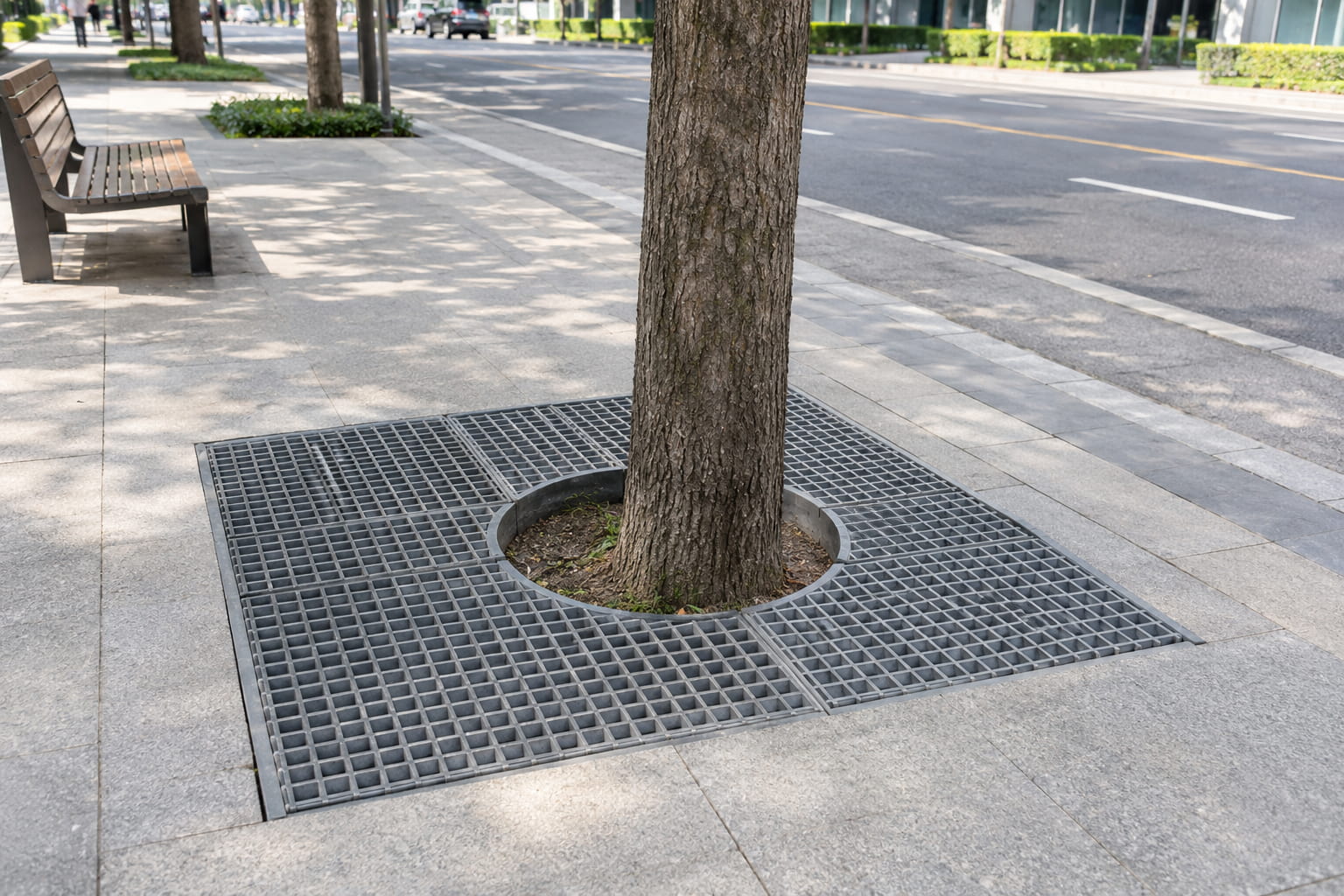
Preet provides FRP tree grates for landscape and urban infrastructure applications, with configurations that can be discussed according to project requirements.
1. Why Use FRP Tree Grates?
Corrosion Resistance
Outdoor tree grates are exposed to rain, moisture, soil, irrigation water, and changing weather conditions. FRP does not rust like carbon steel, making it a potential alternative for installations where corrosion is a concern. The selected resin system and product specification should still be suitable for the actual environment.
Lightweight Handling
FRP grating is generally lightweight compared with many metal alternatives. This can help with handling and positioning during installation and maintenance. However, the finished panel must still be designed for the required loads, and handling procedures should account for the panel's size and shape.
Design Flexibility
FRP tree grates can be considered in different panel configurations, mesh patterns, colors, and central opening arrangements. These options allow designers to coordinate the grate with surrounding paving, landscape layouts, and tree pit dimensions. Actual options depend on the product and manufacturing capabilities.
Reduced Rust-Related Maintenance
Because FRP is non-metallic, it does not require painting simply to prevent rust. Regular inspections remain important, particularly in public areas where panels may experience impact, wear, vandalism, or movement of the surrounding paving.
2. Common Applications of Fiberglass Tree Grates
Urban Sidewalks
Tree grates can help organize tree pits within paved sidewalks and pedestrian routes. The grate layout should maintain a suitable walking surface, avoid abrupt level changes, and comply with local accessibility and public-space requirements.
Commercial Plazas and Office Developments
In commercial landscapes, tree grates can create a neat transition between planting areas and paved circulation spaces. Color and mesh selection can be coordinated with the architectural design, surrounding paving, and landscape plan.
Parks and Public Gardens
Tree pit grating may be used around trees beside paved paths, seating areas, entrances, and other pedestrian spaces. The design should account for maintenance access, drainage, and the long-term development of the tree.
Transit Areas and Pedestrian Corridors
Tree grates can be considered in selected landscaped areas near public buildings, transit facilities, and pedestrian corridors. Before specifying a product, confirm whether the location is intended for pedestrian traffic only or may also experience maintenance vehicles or other concentrated loads.
3. How to Choose the Right FRP Tree Grate
Choosing a tree grate requires more than matching the panel to the visible dimensions of a tree pit. Designers should evaluate the surrounding pavement, support arrangement, expected loading, drainage, and space needed for tree growth.
Step 1: Measure the Tree Pit
Record the overall dimensions of the tree pit and the available space within the surrounding pavement. Confirm whether the opening is square, rectangular, circular, or another shape, and check the dimensions of any existing frame or support structure.
Do not assume that the outside dimensions of the grate are the same as the clear opening dimensions. Confirm the panel and frame drawings before fabrication.
Step 2: Determine the Central Opening Requirements
The central opening must accommodate the tree trunk and allow for future growth. Its shape and size should be coordinated with the landscape designer or arborist, taking account of the tree species, expected growth, trunk flare, and maintenance requirements.
An opening that is too small may restrict the tree as it grows. An unnecessarily large opening, however, can create a gap that may affect pedestrian safety. The opening should be designed for the specific planting and site conditions rather than selected from appearance alone.
Step 3: Select a Suitable Mesh Pattern
Mesh size affects the appearance and practical use of a tree grate. Smaller openings may be desirable in areas with dense pedestrian traffic, while other projects may prioritize drainage, visual openness, or a particular architectural style.
Consider the types of footwear and mobility aids used in the area, as well as applicable accessibility requirements. The mesh pattern should be evaluated as part of the complete walking surface, not as an isolated product feature.
Step 4: Confirm Load Requirements
Identify the expected use of the surrounding area. A tree grate in a pedestrian plaza may have different requirements from one installed beside a service road or in an area accessible to maintenance vehicles.
Confirm the applicable design loads, panel span, support conditions, and product load data with the manufacturer. Do not infer load capacity from panel thickness, mesh appearance, or material type alone.
Step 5: Coordinate the Grate with the Surrounding Paving
Check the grate's overall dimensions, thickness, support frame, edge details, and finished elevation. The installation should minimize trip hazards and avoid creating an uneven transition between the grate and adjacent paving.
Where the grate is divided into multiple sections, confirm how the sections meet, how they are supported, and whether they can be removed for maintenance without disturbing the surrounding pavement.
4. FRP Tree Grate Design Options
Different projects require different configurations. The following table summarizes common design considerations rather than fixed product specifications.
| Design Factor | Possible Options | What to Check |
|---|---|---|
| Overall shape | Square, rectangular, or project-specific layouts | Tree pit dimensions, paving layout, and support frame |
| Mesh pattern | Mini mesh or standard mesh, subject to availability | Pedestrian use, openings, drainage, and accessibility requirements |
| Tree opening | Central opening sized for the project | Trunk dimensions, expected growth, and maintenance access |
| Color | Available standard or custom colors | Landscape design, visibility, and product availability |
| Support and fixing | Project-specific frame and fastening arrangement | Load transfer, stability, removal, and maintenance access |
For available configurations and customization details, consult the Preet FRP tree grate product page and confirm the required dimensions with the supplier.
5. FRP Tree Grates vs. Metal Tree Grates
Both FRP and metal grates can be used in landscape and urban infrastructure projects. The preferred material depends on structural requirements, exposure conditions, aesthetics, maintenance expectations, and budget.
| Comparison Factor | FRP Tree Grates | Metal Tree Grates |
|---|---|---|
| Corrosion | Does not rust like carbon steel; chemical and environmental compatibility still matters. | Corrosion performance depends on the metal, finish, and exposure conditions. |
| Weight | Generally lightweight for handling. | Varies with material and section design. |
| Appearance | Mesh and color options depend on the product. | May offer cast, welded, or other architectural finishes. |
| Maintenance | No rust-prevention painting is needed, but inspections and cleaning are still required. | May require coating maintenance depending on the material and environment. |
| Load verification | Requires product-specific load data and support details. | Requires product-specific load data and support details. |
Neither material is automatically suitable for every location. Always compare the technical specifications of the actual products being considered and confirm their suitability for the intended application.
6. Installation Considerations for FRP Tree Grates
Correct installation helps maintain a stable walking surface and allows the tree pit to remain accessible for inspection and maintenance. Before installing an FRP tree grate, review the following items:
- Inspect the support frame: Confirm that the frame is level, stable, and suitable for the specified loads.
- Verify the opening: Check that the central opening matches the approved design and accommodates the tree without obstructing expected growth.
- Check the finished elevation: Coordinate the grate surface with adjacent paving to reduce uneven edges and trip hazards.
- Confirm drainage: Ensure that the design does not unintentionally obstruct the intended drainage path or irrigation arrangement.
- Use suitable fixing details: Select the frame, fasteners, and restraint method according to the design and manufacturer's instructions.
- Plan for removal: Consider how panels can be accessed for tree care, cleaning, inspection, and replacement.
- Inspect after installation: Check for loose components, rocking panels, damaged edges, and uneven transitions.
If panels need to be cut or modified, obtain the manufacturer's recommendations for cutting methods, edge finishing, and any required protection of exposed fibers. Avoid making unapproved modifications that could affect panel strength or safe use.
7. Common Mistakes When Specifying Tree Pit Grating
Choosing a Grate Without Considering Tree Growth
The tree opening should be designed for the planting plan and expected growth. A grate that fits the trunk at installation may become unsuitable as the trunk expands.
Ignoring Pedestrian Accessibility
Mesh openings, gaps, changes in elevation, and surface condition can affect pedestrian movement. Review the complete installation against the accessibility requirements that apply to the site.
Assuming Every Tree Grate Is Pedestrian-Rated
A product intended for pedestrian areas should not automatically be used where vehicles may travel over it. Confirm the product's design loads, support arrangement, and permitted application before specifying it.
Overlooking the Frame
Even a suitable grate can perform poorly if the supporting frame is unstable, incorrectly sized, or inadequately connected. Treat the grate and its support system as one coordinated installation.
Failing to Plan for Maintenance
Tree pits need ongoing access for cleaning, irrigation, soil management, and tree care. Consider how the grate will be lifted or removed and how the opening can be accessed without creating unnecessary disruption to the surrounding pavement.
8. What Information Should You Provide When Requesting a Quote?
Preparing project information in advance helps the supplier assess the required tree grate configuration and identify details that need confirmation.
- Overall tree pit dimensions and required grate dimensions.
- Tree trunk or planting opening dimensions, including anticipated growth considerations.
- Site location and intended use of the surrounding area.
- Expected loading and whether maintenance vehicles can access the area.
- Preferred mesh pattern, color, and panel arrangement.
- Support frame details and surrounding pavement elevation.
- Required quantity, drawings, and project schedule.
Ask the supplier to confirm the available panel configurations, technical data, load limitations, support requirements, and customization options. Where the installation is part of a public infrastructure project, the design should also be reviewed against the applicable local standards and project specifications.
Conclusion
FRP tree grates provide a lightweight, corrosion-resistant option for selected sidewalk, plaza, park, and landscape applications. The right solution depends on more than the grate material: opening dimensions, mesh pattern, support frame, pedestrian accessibility, drainage, and future tree growth all need to be considered together.
By confirming these details before ordering, project teams can select a tree grate configuration that better fits the site and its maintenance requirements.
Learn more about Preet FRP tree grates or explore the wider FRP grating product range.
Contact Preet for FRP Tree Grate Solutions
Need tree grates for a sidewalk, plaza, public garden, or landscape project? Share your dimensions and project requirements with our team to discuss available configurations.
WhatsApp: +86 138 5147 5666
Email: info@preet.cn
Send your drawings, required quantities, and intended application to help us review the suitable FRP tree grate options for your project.


