

What Are FRP Trench Covers?
Trenches are common in industrial facilities, wastewater treatment plants, commercial buildings, and utility infrastructure. They may be used to carry drainage water, electrical cables, pipes, or other services. Leaving these channels exposed can create access, maintenance, and pedestrian safety challenges.
FRP trench covers are panels made from fiberglass reinforced plastic (FRP) that are designed to cover trenches and channels. Depending on the application, they may use open-mesh grating or a more closed surface. The correct design depends on the trench dimensions, support arrangement, expected loading, drainage requirements, and operating environment.
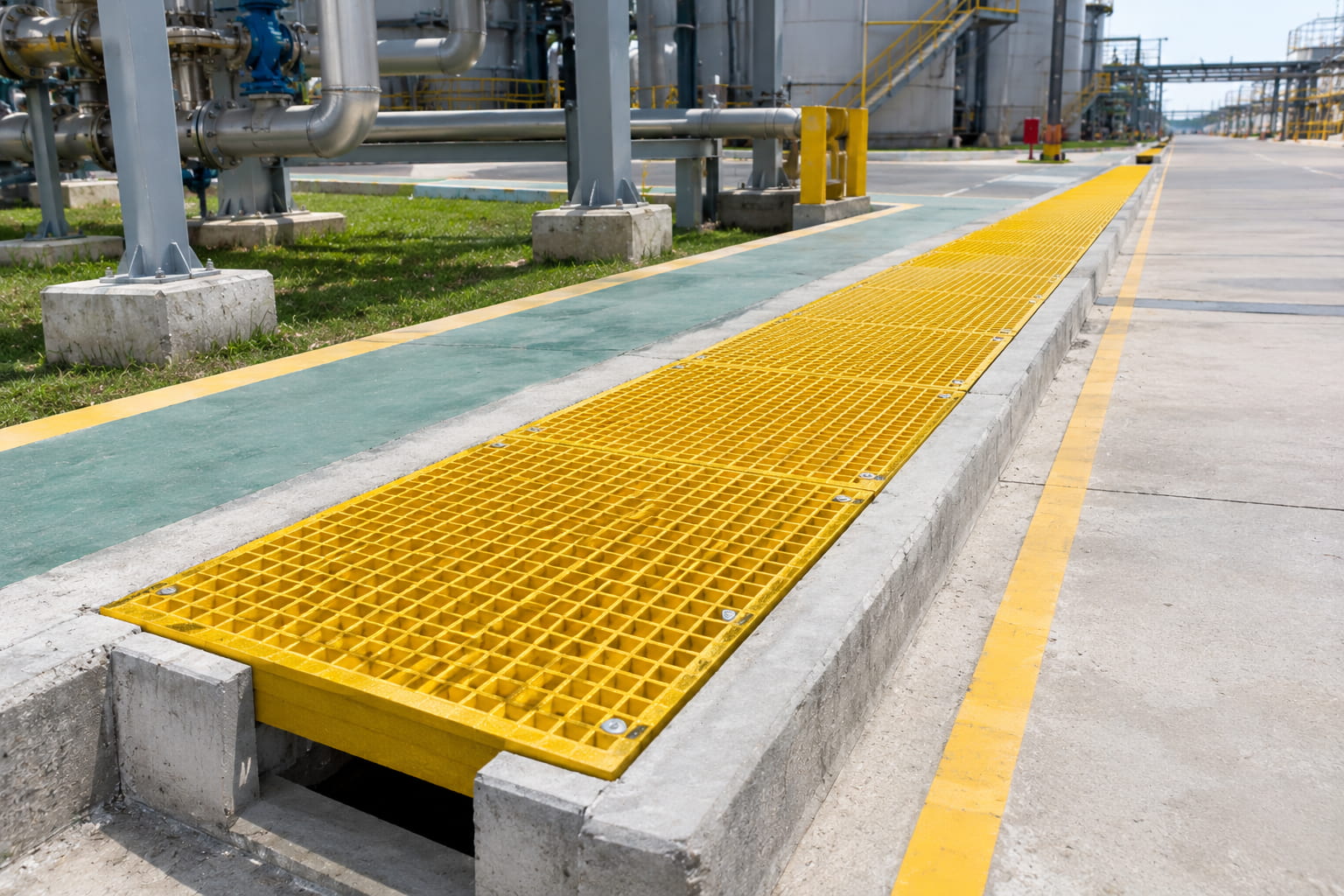
Compared with conventional carbon steel covers, FRP options offer corrosion resistance and relatively low weight. They can be considered for applications where moisture, chemical exposure, or frequent access makes material selection particularly important.
Explore Preet FRP trench covers or the FRP pultruded trench cover product page for more information about available solutions.
1. Where Are FRP Trench Covers Used?
Industrial Drainage Channels
Factories and processing plants often use drainage channels to collect and direct wastewater, wash water, or rainwater. FRP covers can provide a covering over selected channels while allowing maintenance personnel to access the drainage system when required.
Where drainage flow is important, the opening pattern and channel design should be coordinated to avoid restricting the intended flow or allowing unwanted debris to accumulate.
Wastewater Treatment Facilities
Wastewater facilities may expose covers to continuous moisture, cleaning chemicals, and corrosive atmospheres. FRP trench covers can be considered for suitable drainage channels and service areas when the resin system and finished product are compatible with the exposure conditions.
The design should also account for access requirements, cleaning procedures, and any relevant confined-space or operational safety controls.
Electrical Cable Trenches
Cable trenches provide routes for electrical and communication services within industrial facilities, substations, and utility installations. A suitable cover can help protect the trench opening while allowing authorized personnel to access cables for inspection and maintenance.
For cable trenches, consider the required access frequency, water ingress, ventilation, cable arrangement, and the electrical safety requirements of the installation. A non-metallic cover alone does not guarantee that the entire cable trench system is electrically safe.
Utility and Building Service Channels
Service trenches may contain pipes, cables, or other building services. FRP covers can be considered where corrosion resistance, manageable panel weight, and removable access are important. The cover layout should allow maintenance teams to reach the services without unnecessarily disturbing adjacent flooring.
2. FRP Trench Covers vs. Open FRP Grating
Not every trench requires the same type of covering. An open grating allows water and air to pass through its openings, while a closed or covered surface may be preferable where debris control, shielding, or containment is important.
| Factor | Open FRP Grating Cover | Closed or Solid-Top FRP Cover |
|---|---|---|
| Surface structure | Open mesh with distributed openings. | A more continuous surface, depending on construction. |
| Water passage | Can allow water to pass through the mesh. | Water passage depends on the cover design and drainage arrangement. |
| Debris control | Larger debris may pass through the openings. | May reduce direct debris entry from above, depending on edge and joint details. |
| Inspection access | Visual inspection may be possible through the mesh. | The cover may need to be lifted for direct inspection. |
| Typical selection priorities | Drainage, visibility, ventilation, and walking surface requirements. | Surface continuity, shielding, and specific service protection requirements. |
The terms used by suppliers can vary. Confirm the actual panel construction, surface finish, drainage behavior, and intended application before specifying a product.
3. How to Determine FRP Trench Cover Load Requirements
Load requirements are among the most important factors when selecting a trench cover. A panel installed in a pedestrian-only area may require a different design from one that can be accessed by maintenance carts, forklifts, or vehicles.
Identify the Expected Traffic
Start by identifying who or what will pass over the cover during normal operation and maintenance. Consider pedestrians, wheeled equipment, maintenance carts, and vehicles where access is possible.
Do not assume that a cover suitable for foot traffic can safely support a vehicle. If vehicle access is possible, include that condition in the design requirements and obtain confirmation of the product's suitability.
Measure the Unsupported Span
The unsupported span is the distance between the supports that carry the cover. It is a key factor in evaluating bending, deflection, and structural performance.
Measure the actual clear span between bearing surfaces rather than relying only on the overall trench width. Also confirm the available bearing width and the condition of the supporting frame.
Consider Distributed and Concentrated Loads
A cover may experience loads distributed across its surface or concentrated in a relatively small area. These conditions can produce different structural responses.
For example, a person standing on a panel and a wheel passing over it do not apply loads in the same way. Where concentrated loading is possible, verify the product's performance for the applicable load position and support conditions.
Check Deflection and Structural Data
Load capacity alone does not provide a complete assessment. Excessive movement may affect serviceability, the fit of adjacent panels, and the user's perception of stability.
Request the manufacturer's load and deflection data for the exact panel specification, span, and loading condition. Do not estimate allowable spans from appearance or thickness alone.
4. How to Select the Right FRP Trench Cover Size
Correct dimensions help the cover sit securely on its supports and allow maintenance access. Before requesting a quotation, record the following measurements.
- Clear trench width: Measure the opening between the supporting edges.
- Overall cover dimensions: Establish the required panel length and width.
- Bearing width: Confirm how much of each edge will rest on the support frame.
- Panel thickness: Select the thickness using the required span, load, and manufacturer data.
- Panel arrangement: Decide whether the trench will use individual removable panels or a continuous layout divided into sections.
- Access requirements: Identify any sections that need to be removed regularly for inspection or maintenance.
Standard panel dimensions may be suitable for some projects, while others require cutting or custom fabrication. Confirm the available sizes and permissible modifications with the supplier before finalizing the design.
Where multiple covers are installed in a long trench, consider panel weight, lifting access, joint alignment, and the practical sequence for removal and replacement.
5. Choosing an FRP Trench Cover Surface
The surface should be selected according to the operating environment and the intended use of the covered area.
Anti-Slip Surface
Trench covers installed in wet processing areas or outdoor walkways may need a slip-resistant finish. Surface options depend on the product design and may include textured or grit-coated finishes.
Assess the expected exposure to water, oil, cleaning agents, and other contaminants. The suitability of a particular finish should be confirmed against the actual conditions and project safety requirements.
Open Mesh Surface
Open mesh can be useful where water drainage, ventilation, or visual inspection through the cover is important. However, the mesh openings must be appropriate for the location and comply with applicable pedestrian safety requirements.
Closed Surface
A closed surface may be appropriate where a more continuous covering is needed. Before choosing this construction, confirm how water will be managed and whether the cover needs to provide any additional containment or shielding function.
Do not assume that a solid-top cover is automatically watertight, gas-tight, or suitable for pressure containment. These functions require specific design and verification.
6. FRP Trench Covers vs. Steel Trench Covers
Both FRP and steel covers can serve industrial trench applications. The best choice depends on loading, environmental exposure, fabrication requirements, maintenance expectations, and project cost.
| Comparison Factor | FRP Trench Covers | Steel Trench Covers |
|---|---|---|
| Corrosion behavior | Does not rust like carbon steel; chemical compatibility must still be checked. | Depends on the steel grade, protective finish, and exposure. |
| Weight | Generally lightweight relative to many metal alternatives. | Varies with plate or grating design and thickness. |
| Electrical properties | Non-metallic; the full installation still requires electrical safety assessment. | Electrically conductive. |
| Maintenance | Does not need painting simply to prevent rust, but still requires inspection. | Protective coatings and corrosion condition may require maintenance. |
| Load verification | Requires product-specific load data, span checks, and support details. | Also requires structural verification for the intended loading. |
FRP is not automatically the most economical or technically suitable option for every trench. Compare the actual product specifications and expected service conditions before making a decision.
7. Installation Considerations for FRP Trench Covers
Even a correctly specified panel can perform poorly if the support frame or installation details are unsuitable. Review the following points before installation.
Prepare a Stable Support Frame
The supporting edges should be stable, properly aligned, and suitable for the loads transferred by the cover. Confirm the bearing dimensions and ensure that the cover will not rock or shift during normal use.
Check Panel Orientation
Some FRP products have a defined load-bearing direction. Follow the manufacturer's drawings and installation instructions so that the panel is oriented correctly relative to its supports.
Secure the Cover Where Required
Depending on the application, covers may need suitable restraints or fastening arrangements to prevent unintended movement. Select fixing details according to the product design, expected loads, and maintenance requirements.
Maintain a Level Walking Surface
Check the relationship between the cover surface and the adjacent floor or pavement. Uneven edges and unstable panels can create trip hazards, especially in frequently used pedestrian routes.
Plan for Inspection and Removal
Trench covers often need to be removed to inspect cables, clean drainage channels, or maintain services. Consider panel size and weight, lifting access, and any required lifting tools or procedures.
Inspect After Installation
Before the area returns to service, verify that panels are seated correctly, supports are stable, fixing arrangements are complete, and no damage has occurred during handling or installation.
8. Common Mistakes When Choosing FRP Trench Covers
- Selecting by dimensions alone: A panel that fits the opening may still be unsuitable for the required loading or span.
- Ignoring vehicle access: Covers in areas accessible to vehicles require specific load verification.
- Overlooking the support frame: The frame and bearing surfaces are part of the complete structural arrangement.
- Choosing the wrong surface: Surface design should match the expected drainage, contamination, and pedestrian conditions.
- Forgetting maintenance access: Panel dimensions and fixing arrangements should allow the trench to be accessed when necessary.
- Assuming all FRP products are equivalent: Panel construction, reinforcement, resin system, thickness, and load performance can differ by product.
9. What Information Should You Provide When Requesting a Quote?
To help a supplier evaluate the appropriate trench cover, prepare the following project details:
- Application type, such as drainage, cable trench, or wastewater channel.
- Trench width, length, depth, and support-frame dimensions.
- Required panel dimensions and thickness, if already specified.
- Expected loading, including pedestrian, cart, or vehicle access.
- Operating conditions, including chemicals, moisture, temperature, and outdoor exposure.
- Preferred surface type and mesh or solid-cover requirements.
- Required quantity, drawings, and installation details.
- Maintenance access requirements and any applicable project standards.
Ask the supplier to confirm the available construction, technical data, load limitations, allowable span, surface options, and installation recommendations for the exact product being quoted.
Conclusion
FRP trench covers can be considered for drainage channels, cable trenches, wastewater facilities, and other industrial service areas where corrosion resistance and manageable panel weight are important. Selecting the right cover requires coordination between panel dimensions, load requirements, support conditions, surface design, and maintenance access.
Rather than selecting a cover based on appearance or size alone, verify the manufacturer's technical data against the actual trench span and expected loading. A properly coordinated cover and support system can help provide a stable, practical solution for the intended application.
Explore Preet FRP trench covers and FRP pultruded trench covers for industrial project requirements.
Contact Preet for FRP Trench Cover Solutions
Looking for FRP trench covers for an industrial drainage channel, cable trench, or wastewater facility? Send your drawings, dimensions, and loading requirements to discuss suitable product options.
WhatsApp: +86 138 5147 5666
Email: info@preet.cn
Providing the trench dimensions, support details, expected loads, and operating environment will help the team review your project requirements more accurately.


