

FRP Grating Weight Chart: How Much Does Fiberglass Grating Weigh?
FRP grating is widely selected for industrial walkways, platforms, trench covers and access structures because it provides structural performance without the weight of conventional steel grating.
However, there is no single weight for all FRP grating panels. The actual weight depends on several factors, including panel thickness, mesh size, bearing-bar dimensions, resin system, fiberglass content, surface treatment and manufacturing process.
For engineers, contractors and buyers, understanding FRP grating weight is important for transportation, manual handling, installation planning, structural support and project cost estimation.
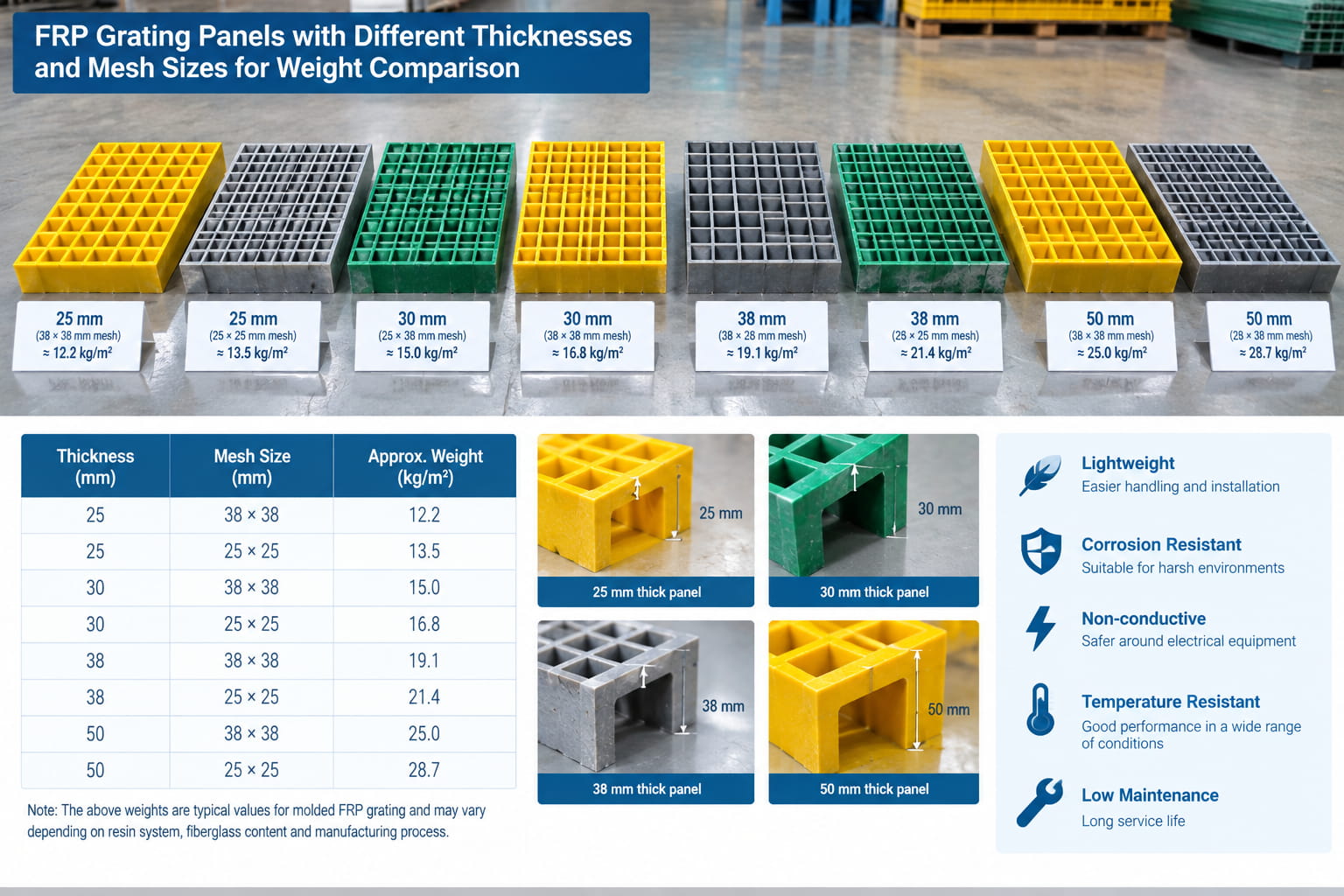
Typical FRP Grating Weight Chart
The following values are typical reference ranges for molded FRP grating. Actual product weight should always be confirmed against the manufacturer's technical data for the selected specification.
| Typical Thickness | Typical Mesh | Approx. Weight Range | Typical Use |
|---|---|---|---|
| 25 mm | 38 × 38 mm | Approximately 12–13 kg/m² | Walkways, light platforms, drainage areas |
| 30 mm | 38 × 38 mm | Approximately 15–16 kg/m² | Industrial walkways and platforms |
| 38 mm | 38 × 38 mm | Approximately 19–20 kg/m² | Heavy-duty platforms and access areas |
| 40 mm | 40 × 40 mm | Approximately 19–20 kg/m² | Industrial flooring and maintenance platforms |
| 50 mm | 40–50 mm mesh | Approximately 23–25 kg/m² | Heavy-duty structural applications |
Preet's current product information provides representative weights of approximately 12.2 kg/m² for 25 mm grating, 15 kg/m² for 30 mm grating, 19.1 kg/m² for 38 mm grating and 25 kg/m² for a 50 mm configuration. These values are associated with specific panel and mesh configurations and should not be treated as universal values for every FRP grating product.
What Determines FRP Grating Weight?
Several design and manufacturing variables affect the final weight of an FRP grating panel.
1. Panel Thickness
Thickness is one of the most obvious factors affecting weight.
As the grating becomes thicker, more fiberglass and resin are required to manufacture the bearing bars and cross bars. Therefore, a 38 mm panel will normally weigh more per square meter than a 25 mm panel of similar construction.
Thickness should not be selected according to weight alone. It must be matched to the required span, loading conditions and allowable deflection.
2. Mesh Size
Mesh size also affects the amount of material contained in each square meter.
A smaller opening generally means more material is present within the same panel area. This can increase weight while also changing drainage, ventilation and pedestrian safety characteristics.
| Mesh Configuration | Material Content | Typical Consideration |
|---|---|---|
| Large mesh | Generally lower material content | Good drainage and ventilation |
| Standard mesh | Balanced material content | Common industrial flooring configuration |
| Mini mesh | Higher material content | Useful where smaller openings are required |
3. Bearing-Bar Dimensions
The bearing bars are the primary load-carrying elements of many grating systems. Their height and width directly affect the amount of material used.
A grating designed for heavier loading may therefore weigh more than a lighter-duty panel even when both products have similar overall dimensions.
4. Resin and Fiberglass Content
FRP grating consists of fiberglass reinforcement embedded in a resin matrix. Different manufacturing specifications can result in different resin-to-fiber ratios and material densities.
For this reason, two products with identical nominal thickness and mesh dimensions may not have exactly the same weight.
5. Surface Treatment
Surface finishes can also have a small effect on weight.
Gritted anti-slip surfaces add a resin-and-mineral coating to the top of the grating, while concave or molded surfaces have different geometric characteristics.
In most engineering calculations, however, the main weight differences come from the structural geometry and material content rather than the surface finish alone.
FRP Grating Weight vs Steel Grating Weight
One of the major reasons engineers consider FRP grating is its relatively low weight compared with conventional steel grating.
| Factor | FRP Grating | Steel Grating |
|---|---|---|
| Typical Handling | Lightweight and easier to handle | Heavier |
| Manual Installation | Often possible for individual panels | May require additional lifting equipment |
| Transportation | Lower mass per panel can simplify logistics | Higher transportation weight |
| Existing Structure | Lower added dead load in many applications | Higher added dead load |
| Corrosion Maintenance | No conventional rust treatment required | May require corrosion protection and maintenance |
Lower weight does not mean lower structural capability. The correct comparison must consider the complete structural design, including span, loading, stiffness and support conditions.
How to Calculate the Total Weight of FRP Grating
For project planning, the total grating weight can be estimated using a simple area-based calculation:
Total Grating Weight = Grating Area × Weight per Square Meter
For example, if a project requires 80 m² of FRP grating and the selected product weighs approximately 19.1 kg/m²:
80 m² × 19.1 kg/m² = 1,528 kg
This gives an estimated grating material weight before accounting for clips, support members, packaging and other installation components.
For procurement and transportation planning, always use the manufacturer's confirmed net and gross weights rather than relying only on a generic chart.
Why FRP Grating Weight Matters During Installation
Weight affects more than shipping cost. It can directly influence how a project is installed.
- Manual handling: Lightweight panels can often be positioned by smaller installation crews.
- Lifting requirements: Lower panel weight can reduce the need for heavy lifting equipment.
- Access limitations: Lightweight components are useful in confined or difficult-to-reach areas.
- Existing structures: Lower dead load can be beneficial when upgrading an existing platform.
- Transportation: More panels can potentially be transported within a given vehicle weight limit.
- Installation speed: Easier handling can reduce labor requirements.
These advantages are particularly relevant to rooftop walkways, wastewater facilities, offshore structures and retrofit projects where access may be limited.
Does a Heavier FRP Grating Always Mean It Is Stronger?
No.
Weight alone should never be used as a substitute for structural data.
A heavier panel may contain more material, but actual load performance depends on the grating geometry, bearing-bar orientation, reinforcement architecture, support span and material properties.
For example, pultruded FRP grating uses continuous reinforcement oriented primarily along the length of the bearing bars. This can provide high directional structural performance without simply relying on a large increase in material weight.
When selecting a grating, engineers should therefore compare:
- Load capacity
- Support span
- Deflection
- Bearing-bar dimensions
- Panel thickness
- Weight per square meter
- Surface requirements
See FRP Grating Load Capacity and FRP Grating Deflection for the structural factors that should be evaluated together with weight.
FRP Grating Weight and Support Spacing
The weight of the grating itself contributes to the dead load carried by the supporting structure.
However, support spacing should not be determined simply from panel weight. The structural system must also account for live loads, concentrated loads, impact loads and allowable deflection.
For installation planning, see FRP Grating Support Spacing: How to Determine Beam Spacing.
This distinction is important because a lightweight panel can still require carefully designed support spacing when subjected to significant service loads.
FRP Grating Weight for Transportation and Shipping
Weight per square meter is useful when estimating shipment quantities.
For example, a project using 200 m² of grating at 15 kg/m² would require approximately:
200 × 15 = 3,000 kg
However, the actual shipping weight will be higher after adding:
- Packaging materials
- Pallets or skids
- Fasteners and clips
- Protective materials
- Other fabricated components
International shipments should therefore use the supplier's confirmed packing list and gross weight for logistics and customs documentation.
How to Choose FRP Grating Thickness by Application
Thickness should be selected based on engineering requirements rather than simply choosing the lightest available product.
| Application | Typical Selection Consideration | Weight Priority |
|---|---|---|
| Light-duty walkway | Load and span requirements first | High |
| Industrial platform | Balance load capacity, span and weight | Medium |
| Heavy-duty platform | Structural performance takes priority | Secondary |
| Rooftop access walkway | Weight, UV exposure and maintenance access | High |
| Offshore platform | Corrosion, load, fire and environmental requirements | Medium |
Molded vs Pultruded FRP Grating: Weight Considerations
FRP grating can be manufactured using different processes, and this affects its geometry and structural characteristics.
Molded FRP grating is commonly used for general industrial platforms, walkways, drainage areas and corrosive environments. The reinforcement is distributed in multiple directions.
Pultruded FRP grating uses continuous longitudinal reinforcement and is often selected when higher directional strength and longer spans are required.
Neither manufacturing method should be judged by weight alone. The appropriate product depends on the structural load path and project requirements.
For a direct comparison, see Pultruded vs. Molded FRP Grating.
FRP Grating Weight Checklist for Buyers
Before placing an order, confirm the following information with the manufacturer:
- Panel thickness
- Mesh size
- Bearing-bar dimensions
- Panel length and width
- Weight per square meter
- Total required area
- Total estimated net weight
- Packaging and gross shipping weight
- Surface type
- Resin system
- Load rating and support span
Providing this information helps prevent mistakes when comparing quotations from different suppliers because two panels with the same nominal dimensions may have different material specifications and weights.
Final Thoughts on FRP Grating Weight
FRP grating is lightweight compared with many traditional metal flooring systems, but its exact weight depends on the complete product configuration.
For a reliable FRP grating weight estimate, start with thickness, mesh size, bearing-bar geometry and weight per square meter. Then calculate the total project area and add packaging and accessories when planning transportation.
Most importantly, weight should be considered together with load capacity, deflection, support spacing, resin selection and environmental requirements. Choosing the lightest panel is not necessarily the best engineering decision.
Request an FRP Grating Weight and Specification Quote
If you have a project drawing or know the required panel area, thickness, mesh size and load conditions, Preet can help confirm the appropriate FRP grating specification and estimated shipment weight.
WhatsApp: +86 138 5147 5666
Email: info@preet.cn


